Yves here. I hope you will appreciate this meaty offering by Joseph Busby of the Reality-Based Analysis Group on Iran’s strategic reasoning and priorities. I enjoyed it and found it presented some issues in a way that helped my understanding. For instance, Alastair Crooke has often emphasized on how the Shia faith reveres martyrdom. Professor Mohammed Marandi has talked about the strong moral foundation of Shia Islam. But this piece, at least for me, gave a much stronger sense, and in a short space, as to why both are foundational. It also has important background, such as how Iran came to develop its ballistic missile program, that I had not seen before.
Even though this article was published in July, its observations are still germane.
By Joseph Busby, Founder & Director, Reality-Based Analysis Group, an independent geopolitical analysis firm based in Vienna, Austria. RBAG is affiliated with the Association for the Promotion of International Development and Stability (APIDS — apids.at). Originally published at its website
Iran entered the war of 2026 confident of victory and the progression of the conflict thus far has not only validated its strategy, but has also left Iran more deeply integrated into the multipolar order than ever before; and it may have made diplomatic solutions with the West impossible.
Confident of Victory
Prior to the February 2026 joint Israeli-US attacks on Iran, both sides were confident their side would emerge victorious. In part, this was due to the starkly different concepts of victory held by each combatant. Israel and the United States, in their hubris, defined victory as complete regime change and the removal of Iran as a strategic threat to Israel and Western interests in the Gulf. Iran defined victory as the survival of the regime and the maintenance of territorial integrity. Given the geography of Iran, its ability to close the Strait of Hormuz, its vast array of highly protected advanced intermediate-range ballistic missiles, and the “mosaic” strategy of diffused autonomy in the event of presumed assassinations of its political and military leadership, Iran entered the conflict supremely confident of emerging intact. Further, bolstered by the results of the 12-day missile war against Israel in June 2025, in which Iranian missiles proved highly effective in piercing both US and Israeli defensive shields, Iran was confident that it could wreak significant devastation on US military bases and, barring Western use of nuclear weaponry, control escalation dominance. These are rational, measurable assessments by Iran of its pre-February 2026 situation, and far from being a surprise, they were publicly announced by the Islamic Republic in an attempt to warn the United States and Israel against attacking. Iran stated explicitly what would happen in the event of US and Israeli aggression and its warnings were not heeded. When the war proceeded, Iran absorbed the military blows, executed its mosaic diffusion of power when its Supreme Leader and senior military officials were assassinated, and systematically followed through with each and every one of the consequences it promised in the event of war.
Through the June pause in fighting, the Iranian government not only remained intact, it emerged from the conflict stronger than ever before. Israel has been severely chastened and damage to United States bases in the region is so significant that some may be abandoned rather than rebuilt. The renewed fighting has thus far reinforced rather than reversed this situation.
This essay attempts to explain Iranian strategic logic on its own terms. It will explain why Iran was confident of victory, why Iran can be said to be winning the war and why it will emerge from it in a stronger strategic position than ever before. It will address how Western attempts to destroy this BRICS member have instead forged greater and stronger multipolar bonds, and why diplomatic efforts between the West and Iran, as well as others in the multipolar world, are likely damaged beyond repair for at least a generation.
The Underlying Logic

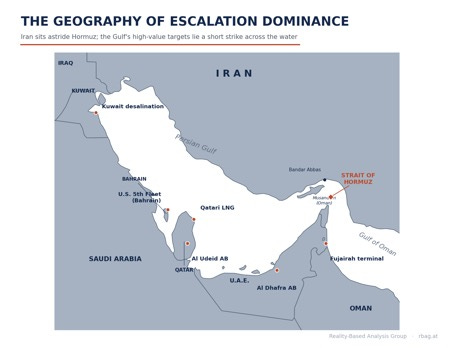
Iran’s defensive geography and the Gulf’s high-value targets within reach.
Iranian strategy is based on three basic pillars: geography, history, and ideology. Iran, much like the United States, benefits significantly from geography. Iran is a high plateau, ringed by the Zagros and Elburz mountains, and sits astride the northern shore of the Strait of Hormuz, including its narrowest point, allowing near de facto control of the Strait should it wish to seize it. A glance at the map reveals the near impossibility of successful invasion, and a glance at any history book shows the futility of all previous attempts. A civilization lasting over two and a half millennia, in no small part due to its geography, thus inhabits terrain both unusually defensible and unusually able to impose significant economic costs on others. This is the first and perhaps most important factor in the Iranian strategic position. It is also extremely obvious.
Less obvious to the West is Iran’s lived memory, not of ancient invasions repulsed, but of the war launched by Iraq and its Western backers in 1980, fought for eight years, often with Western-supplied weapons, including chemical weapons. Iran paid an extraordinary price: the war killed or wounded approximately a million Iranians, gassed up to a hundred thousand, displaced millions, and directly touched, through service or loss, an enormous share of an entire generation, and the consciousness of them all. Few came to Iran’s aid during the eight-year conflict and Iran took several lessons from the war. First was that no one would intervene on its behalf and that if it were to defend itself in the future, it would be its own responsibility. Second was that in conflicts initiated by the West, International Law and International Humanitarian Law were not viewed by the West as applicable in conflicts in which they held an interest. Iran recognized that successful self-defense required flexibility, independence, and self-reliance.
Completely ignored by the West is the Iranian doctrine of self-reliance developed over this period, exemplified by Ayatollah Ruhollah Khomeini’s two famous slogans “Neither East nor West” and “Neither Oppress nor Accept Oppression.” The former emphasizes Iran’s view of itself as a civilization independent from external political orientation or alliance. The second represents the Islamic Republic’s view of power itself and is rooted in its religious tradition, equally misunderstood, when considered at all, by the West. As argued by Flynt and Hillary Mann Leverett in their masterwork Going to Tehran, Iran is a rational actor on the world stage and a state supremely committed to an independence fundamentally at odds with any and all attempts by foreign powers to dominate or subjugate it. Their book argues that Washington should engage with Iran in much the same way it did and does with China. Instead, Washington opted for attempted hegemony and domination and failed completely. Perhaps the most important reason why is a specific Western blindness to a motivating force driving Iranian behavior: a culture of honor.
Karbala and the Fight Against Empire
Iranian honor is a strategic concept unfactored into Western military planning, in part due to its incompatibility with Western modes of thinking. Iranian understandings of honor are rooted in the opposing concepts of “ezzat” and “zillat,” the first being dignity, glory, and strength and the second representing humiliation and abasement. Striving towards the former and avoiding the latter are foundational parts of Iranian national identity. Prior to his assassination in the opening salvos of the Israeli-US attacks, Supreme Leader of Iran Ayatollah Khamenei organized Iran’s foreign policy around the concepts of “dignity, wisdom, and expediency,” explicitly in that order, with dignity in the forefront. Thus, inherently, Iran is incapable of agreements, including one to end the current conflict, incompatible with its dignity, those it views as capitulation rather than compromise.
This understanding, vivid in the mindset of the Islamic Republic, stretches back almost 1,400 years and involves Karbala, nearly invisible to Western strategic thinkers. In the year 680, Hussein, grandson of the Prophet Mohammed himself, refused to pledge allegiance to Yazid, the Umayyad caliph, whom he considered to be a usurper and a tyrant. As a result, Hussein and several dozen of his followers were killed at Karbala on the day remembered as “Ashura.” This event became the moral core of Shia Islam in which the deliberate choice of death over the dishonor of submission to an illegitimate power became a story of the primacy of honor over life and victory by refusing dishonorable compromise. Viewing Iranian strategy through the lens of Ashura and Karbala reveals a motivation organized around the concept of justice and injustice rather than one based on likelihood of success. Further, in this framing, every confrontation with an overwhelming power is cast in terms of Hussein’s resistance and the moral center of the Islamic Republic’s Shia identity.
Here there is clarity in what Iran means when it discusses a fight against “Imperialism.” In Ayatollah Khomeini’s worldview, humanity was divided between the oppressed and downtrodden, the “mostazafin,” and the “mostakberin,” those who arrogantly dominate them. In the current conflict, the United States is the modern Yazid, a hegemon brazenly exercising power in a foreign land, imposing crippling sanctions, propping up client regimes, favoring a hostile Israel, surrounding the country with military bases. Iran naturally casts itself as fulfilling the mandate of Hussein, refusing a domination it considers tyrannical from a power usurping control in an area not its own. This understanding of foreign policy is not a negotiating point up for debate and consideration, it is the moral and religious core of society and the state itself.
Mohammad Marandi, Professor of English Literature and Orientalism at the University of Tehran, stated it plainly, “Iran cannot be bombed into surrender.” Marandi, a soft-spoken intellectual whose fluency and dignity begin to fill the communications void left in the absence of assassinated Iranian official Ali Larijani, provides a window to Iranian culture. Having volunteered himself in the Iran-Iraq war, surviving two chemical weapons attacks, he remains extremely close to the ruling elite, yet speaks for his generation as well when he notes that Western bombing is finite and Iranian will is not. A state which considers the dignity, glory, and strength of “ezzat” as more important than tactical victories or diplomatic compromises is not one who can be brought to the negotiating table by overwhelming force. This, even more than geography and experience, is why Iran was and remains confident in inevitable victory. Iran has no need to destroy its enemies. However, short of the overwhelming utilization of nuclear weapons, those enemies cannot force a capitulation that is fundamentally contrary to Iranian identity itself.
The Twelve-Day War and Iran’s Red Lines
All of this was knowable to the West, especially after the experiences of June 2025. That conflict was instigated by Israel with a decapitation strike, months in the making, which killed a large number of Iran’s senior military officers. The United States bombed multiple sites associated with Iran’s nuclear enrichment program. Iran’s response was significant: over the course of what would become known as the Twelve-Day War, Iran launched over five hundred ballistic missiles, with a strategy of firing ever more advanced weapons as older models systematically depleted Israeli and US missile defenses. These missiles struck strategic targets throughout Israel, including military headquarters, oil refineries, military facilities, and precision strikes against “secret” military and intelligence facilities hidden in densely populated areas. The strategy was successful and drew down the United States’ highly prized (and difficult to replace) THAAD interceptor stocks by at least a quarter. Iran’s response to the bombing of its nuclear facilities was a pinpoint accurate strike on the American Al Udeid air base in Qatar. Hostilities ceased at the request of the Israeli state, a controversial decision in Iran.
The strategic message was clear and the red lines were explicit. Iran stated publicly that in the event of an Israeli or US strike, Iran would retaliate against US bases in the Gulf and that it would close the Strait of Hormuz. The West had every reason to know that advanced Iranian missiles had the ability to pierce Israeli and American defensive shields and destroy with unprecedented accuracy a clearly defined target list. Further, Iran briefly closed part of the Strait both as a warning and a threat. For a moment it appeared that war hawks in Washington and Tel Aviv listened, but instead of calling off hostilities, they pivoted to other means.
Economic Hit Men and the Failed Color Revolution
The failure of the Twelve-Day War to break Iran kinetically prompted Washington and Tel Aviv to opt for the equally well-trodden ground of covert regime change. They turned to the economic hit men, those whose efforts are designed to destroy adversary powers by destroying the economies and the economic lives of their people, weakening regimes and priming them for toppling in a “color revolution” painted as indigenous yet infiltrated and exploited by covert Western actors.
In this case, as proudly announced by US Treasury Secretary Scott Bessent on multiple occasions, the United States exerted “maximum pressure” on the Iranian economy with the explicit goal of creating domestic discontent, and thus protests, in order to set the stage for regime change. Bessent engineered the devaluation of the Iranian currency, the rial, via an intentional dollar shortage which resulted in the failure of a major bank. This caused a plummet in the rial and explosive inflation, intentionally destroying in one swoop the economic lives of a significant proportion of the population with the specific and publicly stated intent to bring them into the streets in protest.
Bessent called it “economic statecraft with no shots fired,” an inaccurate moral side-step papering over the fact that the protests, initially consisting of innocent civilians damaged by US economic policies, were openly infiltrated, manipulated, and injected with steadily increasing violence by both Israeli and US intelligence operatives. Mossad “assured” Iranians that they were “with them in the field” and none other than former Secretary of State and CIA Director Mike Pompeo himself publicly saluted every Mossad agent “walking beside” the protesters. They did more than walk: they smuggled and prepositioned thousands of Starlink terminals across the country and steadily increased violence against the state and its officials. The public claims of accountability were noted by Iran.
Tehran responded forcefully, cutting the internet throughout the entire country and exposing the Starlink terminals with sophisticated electronic warfare, tracking down and arresting their operators. The crackdown against the violent protesters, once marching beside the mostly innocent civilians who had gone home at the first sign of violence, was unsparing. Specific casualty figures are difficult to confirm but number in the thousands.
The strategic situation was clear: the United States and Israel, having failed to break Iran in the Twelve-Day War, had taken public credit for an attack on Iran’s economy, with specific intent to cause a series of protests that people associated with both countries’ intelligence services explicitly stated were infiltrated by intelligence operatives designed to bring about the downfall of the government. This is classic covert regime change, missing only the “successful” overthrow. Western framing of the event as homegrown was belied by the boasting of Bessent and Pompeo, and Iran listened, learned, and understood that while the battle had been won, the war was unlikely to be over. It was correct.
Shattering the Ceasefire

The sequence from the Twelve-Day War to the collapse of the June 2026 Memorandum of Understanding.
The results of the Twelve-Day War and the failed attempt at covert regime change were clear and Iran’s warnings were heard by the West, if not heeded. Indeed, General Dan Caine, Chairman of the Joint Chiefs of Staff of the Pentagon, advised that a war with Iran would severely deplete defensive missile stockpiles and pointed out the “enormous difficulty” the US would have in attempting to reopen the Strait of Hormuz if Iran opted to close it. Vice President JD Vance called the idea of war a “disaster,” Secretary of State Rubio was against it, and CIA Director John Ratcliffe had already labeled the idea of attempting regime change as “farcical.” Trump, however, following an in-person briefing delivered in the Situation Room of the White House on 11 February 2026 by Israeli Prime Minister Netanyahu, joined virtually by Mossad head David Barnea, was convinced that the Iranian regime was fragile and would collapse and capitulate if attacked by both the United States and Israel. He dismissed the warnings of his most senior advisors, stating that even if the Iranians closed the Strait of Hormuz, the US Navy would simply reopen it. He ordered the attack.
Despite their robust abilities, neither Israel nor the United States is known for their deep understanding of the cultures of their adversaries and Barnea, Netanyahu, and Trump do not appear to have considered the role played by honor in Iran’s strategy, let alone understood that capitulation was unthinkable to the Iranians. On 28 February, Israel and the United States shattered the June 2025 ceasefire and the war began with the unprecedented assassination of the Supreme Leader of Iran, Ayatollah Khamenei and members of his family, along with a significant number of Iran’s most senior military and political leaders. Iran absorbed the decapitation strikes and the ferocious initial barrage of missile attacks and, far from collapsing, followed through with each and every one of its pre-war promises. It closed the Strait of Hormuz immediately and it unleashed a sustained barrage of missiles against US bases in Qatar, the United Arab Emirates, Kuwait, and especially Bahrain. Washington and Tel Aviv responded with shock, echoing Western media reporting of Iranian retaliation as “unprovoked.” This shock was real and was the result of substituting hubris for analysis. The failure to assess Iran on its own terms led to a willful ignoring not only of Iranian warnings, but of all the data indicating that Iran could and would back up its threats with action. That data stretches far earlier than the Twelve-Day War and it reveals a long-term multi-pronged Iranian strategy that explains its success.
Missiles, Missile Cities, and Escalation Dominance

Iran’s declared 2,000 km reach against the US and allied base network.
How did Iran develop such effective missiles? Simply put, Iran saw an opportunity in the 1987 Intermediate-Range Nuclear Forces Treaty signed between the United States and the USSR. Whereas the treaty bound the US and USSR (and later Russia) to eliminate all ground-launched ballistic and cruise missiles with a range between 500 and 5,500 kilometers, Iran was not a party to the treaty. Thus, between 1987 and 2019 (when the United States withdrew from the treaty) while Russia and the US destroyed their intermediate-range missile capability, Iran filled the gap by focusing on developing, improving, and mass producing the heart of its missile arsenal, advanced, indigenously produced solid-fuel missiles that reach all four corners of its region and, potentially, well beyond. Iran’s most advanced missiles, the Fattah-class missiles, apparently hypersonic with unprecedented maneuverable reentry warheads, are allegedly impossible to intercept in terminal phases; neither Israel nor the United States currently possesses any deployed hypersonic weapons.
The precise range of Iranian missiles is unknown. Tehran publicly declared a limit of 2,000 kilometers, more than sufficient for reaching its nearby adversaries. However, on 20 March 2026 two missiles were reportedly fired at the US-leased British military base of Diego Garcia, a distance twice as far as the presumed Iranian range. While Iran declared the attack to be one more false flag among many, American and British officials publicly accused Iran of launching the missiles, neither of which made it to their target (one falling short and the other intercepted). Thus, the true range and capacity of Iran’s missile arsenal remain unknown and this ambiguity benefits Iran strategically, as the United States and Israel cannot operate with complete confidence that they are outside Iranian missile range, even at double the distance previously believed.
One of the many lessons of the war of the 1980s was the need to protect its arsenal from heavy aerial bombardment. Iranian strategic planners opted for concealment and survivability and constructed the naturally fortified “missile cities,” hardened military bases carved out within mountains, housing the production facilities, storage, and firing line of Iran’s missile arsenal. Dispersed across the country, these literal mountains can withstand sustained heavy bombing without the bases below being put out of action; they remained able not only to continue firing, but to continue firing at the speed and pace of Iran’s choosing. One example is the missile complex outside Yazd, reported to be protected by over 1,500 feet of granite mountain, and producing hundreds of missiles every month. Less protected, however, were the more exposed mobile missile launchers, and the IRGC was estimated to have approximately 480 mobile transporter-erector-launchers at the start of the war. A primary target for US and Israeli strikes, Western estimates suggest that 80% of the inventory was destroyed during the first phase of the war, which matches a concomitant reduction in Iran’s missile launch rate. However, the US/Israeli objective of the war was not the degradation of Iranian mobile missile launchers; it was Iranian capitulation and regime change, and as the dust cleared from a Western barrage of over thirteen thousand strikes, Iran’s missile cities were still producing missiles and still firing them.
Its missile arsenal, its protected missile cities, and its favorable geography were the basis behind Iran’s confidence that it, rather than the United States or Israel, possessed escalation dominance (at least below the threshold of nuclear weapons). The United States assumed that it and Israel were the ones who could methodically increase or decrease the level of pain inflicted upon its adversary until it capitulated or collapsed. Iran was confident that it was the opposite, and it demonstrated this swiftly, warning and then striking at the vast array of targets across the Persian Gulf. Hitting American bases, Kuwaiti desalination plants, Qatari liquefied natural gas facilities, hotels in Dubai housing Western military and intelligence officers, each successful Iranian strike served to reinforce Iran’s dominant position. Iran went further, broadcasting in advance expanded potential target lists, informing the United States and Israel that it would reciprocate against strikes on Iranian infrastructure, including universities, high-tech companies, and financial centers, by striking a specific named list of equivalent targets in surrounding nations, allied to the United States. Further, the most obvious and perhaps greatest escalatory tool is the Iranian ability to open and close the Strait of Hormuz. As noted, Iran had threatened to close the Strait if attacked, and it followed through, with the economic results still echoing across the globe. Iran has stated that there shall never be a return to the status quo ante of “free passage through the Strait,” but declares that it is permanently under Iranian administration via the newly created Persian Gulf Strait Authority (PGSA). “Opening” the Strait has become the diplomatic concession, rather than abandoning it, with the recent Memorandum of Understanding laying out that passage shall not be monetized “for 60 days.” This is perhaps the most vivid example of Iran’s escalation dominance, in that unlike its precision strike abilities, which are limited to the range of its missiles, Iran’s ability to open or close the Strait of Hormuz at will impacts the entire world. The creation of the PGSA and Iran’s move to monetize passage (both before and after the 60 days stipulated in the MOU) represent not only escalation dominance in combat operations, but a wholesale shift in the power structure of the Gulf and stand to become a major revenue source for the Islamic Republic. This bid for a power shift and revenue source is being contested by force.
The Mosaic Defense
In addition to the misreading of who possessed escalation dominance, the United States and Israel both fundamentally misunderstood the very structure of power throughout the Iranian military and political systems. They failed to understand that decapitation strikes would not collapse or confuse the regime because the systems were built with the understanding that the technique of assassination was likely to be used against them. Militarily, the doctrine of “defa’e mozaiki,” or “mosaic defense,” was implemented throughout the IRGC in 2008. After witnessing the US removal by force of heads of state ranging from Libya to Afghanistan to Iraq and noting the US and Israeli technique of targeted assassinations, the IRGC was reorganized to withstand such attacks. In the event of an assassination, command is automatically diffused throughout the country, with hierarchies of command pre-designated and pre-authorized to engage militarily with their attackers, including the authority to launch missiles internationally.
A diffused system of command cannot be decapitated. Yet the political leadership did not collapse either; indeed within days, Mojtaba Khamenei, the son of the murdered Ayatollah, was installed as the new Supreme Leader, and throughout, Iranian missiles kept flying and drones kept launching. One downside of the diffusion of authority is that escalation becomes more likely and de-escalation more difficult as multiple groups are operating simultaneously but not synchronously. One result of this was a missile strike on Oman, specifically attributed by Iranian Foreign Minister Araghchi to this effect of the mosaic defense.
Politically, the West appears to have believed that the assumptions underlying their earlier attempt at covert regime change, namely that the population would naturally rise up against their ruling class, viewing them as oppressors, would hold true if the leadership of the country was simply killed. Instead, perhaps in part motivated by the simultaneous tragedy of the killing of 168 innocents, mostly children, at the Minab school on the opening day of the war, the Iranian population rallied around its government. When Mojtaba Khamenei was selected as Supreme Leader by the Assembly of Experts, in accordance with Article 111 of the Iranian Constitution, the people indeed rose and filled the streets and squares, but, to Western chagrin, they did so in support of their country and its leadership, not to bring it down.
Unintended Integration
The Islamic Republic’s resoundingly independent founding doctrine of “Neither East nor West” had long evolved into “negah be sharq,” the “Look East” policy, as geopolitical reality shifted from a Cold War paradigm through the unipolar moment and into the emergence of multipolarity. Iran had become a full member of the Shanghai Cooperation Organization in 2023 and joined BRICS officially in the following year. Iran held SCO military exercises with both China and Russia, on Iranian territory, yet it did not enter into any military alliances or defense obligations with either country, and it was emphasized by Iranian Foreign Minister Abbas Araghchi that the “Comprehensive Strategic Partnership Agreement between the Islamic Republic of Iran and the Russian Federation,” signed in January 2025, “includes cooperation in the area of security and defense but doesn’t set a goal of establishing a military alliance.” Russian President Putin himself confirmed publicly that the agreement did not include “military help” and in June 2025, he confirmed that, indeed, Iran had not asked Russia for any.
These decisions preserved Iranian military independence, but at a cost, as Iranian capabilities lagged significantly behind both China and Russia in the critical trio of intelligence, surveillance, and reconnaissance (ISR), particularly space-based imagery. Iran had already shifted, beginning in 2024, away from the American Global Positioning System (GPS) into the Chinese encrypted BeiDou-3 military technology, and as the conflict with the United States expanded, the ability to track American warships or access precise targeting data appeared to be significantly improved. Western accounts alleged Russian and Chinese support including precision targeting and post-strike assessment imagery from military satellites; both Russia and China deny this charge, although President Putin did state, speaking with Araghchi in Saint Petersburg in April 2026, that Russia “would do everything that serves [Iranian] interests.” One thing that served Iranian interests was a Russian advanced electronic-warfare system, the Krasukha, a truck-mounted military broadband jammer designed to interrupt an enemy’s ISR platforms. Another is the Murmansk-BN, a similar, longer-range system. Neither Russia nor Iran confirmed the transfers, and reports of their systems rely heavily on Western reporting and OSINT imagery. It is feasible that Iran has successfully made indigenous copies of the Russian technology, much as Russia has done with the Iranian Shahed drones, now the Russian Geran drones, used in the conflict in Ukraine. China, too, denied sharing geospatial intelligence with Iran but the United States issued a set of sanctions against Chinese satellite firms specifically on the allegation that they were sharing targeting data with Tehran. When confronted, Araghchi commented only that “military coordination” with Russia and China “continued.”
The pattern is clear: as Western threats to Iran become more acute, Iran’s response is further integration with its allies rather than further isolation. American withdrawal from the Joint Comprehensive Plan of Action (JCPOA) in 2018 and increased Western sanctions led to Iran “Looking East,” joining the SCO and BRICS, and deepening regional ties with Pakistan, developing the International North-South Transport Corridor (INSTC) and tying in with the burgeoning China-Pakistan Economic Corridor (CPEC). US and Israeli wars against Iran in 2025 and 2026, designed to destroy Iran and ensure American and Israeli dominance in the Gulf, instead are resulting in a deepening of ties between Iran, Russia, and China, an enrichment of Russia due to increased energy costs resulting from the closing of the Strait of Hormuz, and the potential emergence of a regionally dominant Iran, no longer surrounded by a ring of hostile American bases, flush with consistent revenue via PGSA administration of fee-for-passage transit rights through the Strait of Hormuz. Yet again, unipolar overreach is resulting in the advance of multipolarity.
The Poisoned Well
Notwithstanding the signing of the Memorandum of Understanding, the war is far from over. The symbolism of the American President signing it in Versailles was appropriate to the terms overwhelmingly favorable to Iran, which were then violated immediately by the United States and Israel. The June and July pauses in active conflict, punctuated by constrained attacks and counterattacks, were marked by a flurry of activity in the background. Each side rearms and prepares for the next round, while the region is thrust into ever-increasing chaos. Israel continues military activities not only in the Palestinian territories, but in ever greater parts of Lebanon. The United States is attempting to involve the Kurds; Baghdad is riven by violence and rumors of military coup attempts amid a major and violent “crackdown,” and the United States has openly threatened to “blow up” Oman if it cooperates with Iranian plans to co-administer the Strait of Hormuz. The way forward from such deepening crises is usually either diplomacy or a wider conflict. Here, alas, the well of diplomacy has been poisoned.
In January 2023, Russian Foreign Minister Sergei Lavrov made famous the Russian term недоговороспособный (nedogovorosposobny), describing the United States as “not-agreement-capable,” meaning that it was not possible to even negotiate an agreement with the United States as there is no faith that it will be honored or that there was ever any intention for it to be honored. Iran, too, listened and learned: from German Chancellor Merkel’s admission of the perfidious Western manipulation of the Minsk agreements to buy time for Ukraine to rearm and later fight Russia; from Israel’s attempted assassination of Hamas negotiators in Qatar during peace talks; from the United States pushing for peace in Ukraine while flooding the country with weapons and intelligence support. The decapitation strikes which started the current conflict took place in the middle of peace negotiations between Iran and the United States, negotiations which were so promising that Omani mediators reportedly had already purchased the pens for the signing ceremony scheduled to take place in Vienna the following week. The assassination of Iranian senior official Ali Larijani, critical in the peace talks, and continued threats by the United States President to “end Iranian civilization” and murder the Iranian diplomatic negotiators if they fail to accept American “terms,” reinforce Lavrov’s assessment. Perhaps worse, they make a mockery of any potential peace agreement short of abject Iranian capitulation. This does not take place in a vacuum, and the lessons taught in Iran are learned in Russia, in China, in Cuba, in every country that knows that it too may find itself on the wrong end of American attention. The Iranians have been explicit: Foreign Minister Araghchi himself has flatly declared that Iran “cannot trust the Americans at all.”
This may be the greatest long-term American strategic failure of this war. A conflict justified to the world as necessary to prevent Iranian acquisition of nuclear technology reveals itself to be potentially unresolvable diplomatically as the only offered terms are surrender. A conflict that can only be won by the West by the use of nuclear weapons, and one in which Iranian possession of those very same weapons may have been the only way to prevent the attack, reveals the inescapable logic of proliferation. By murdering Iran’s leadership during negotiations, immediately breaking and then misrepresenting the published terms of the MOU, threatening the annihilation of a country and the genocide of its people, and the lives of the Iranian negotiators should they fail to accept dictated American “terms,” the United States has poisoned the well of diplomacy not only in this conflict, but globally. This is our verdict on this war; expect de facto solutions after further conflict, not finely wrought and carefully followed peace agreements. Barring Israeli or United States use of nuclear weapons, Iran will emerge from this conflict tangibly strengthened politically, with a significant and sustained new revenue stream from its control and administration of the Strait of Hormuz, and with deeper integration into the multipolar order than ever before. Iran entered the war on its own terms and according to those terms, it will win it.
Postscript: The interval between the writing of the above essay and its publication saw the collapse of the Memorandum of Understanding, the failure of a subsequent Islamabad-brokered ceasefire, and nearly two weeks of the most intense fighting of the war, with American strikes on almost one hundred locations in a dozen Iranian cities and Iranian fire on Bahrain, Kuwait, the UAE, Saudi Arabia and Jordan. Iran has again declared the Strait of Hormuz closed until further notice. Hostilities between Saudi Arabia and Ansar Allah in Yemen have restarted with reciprocal attacks and a partial closure of the Bab el-Mandab Strait. As of publication, both sides have paused strikes amid disputed reports of a resumption of diplomatic negotiations, claimed by the United States, denied by Iran.