It’s time to stop favoring straight white men in everything the party does.
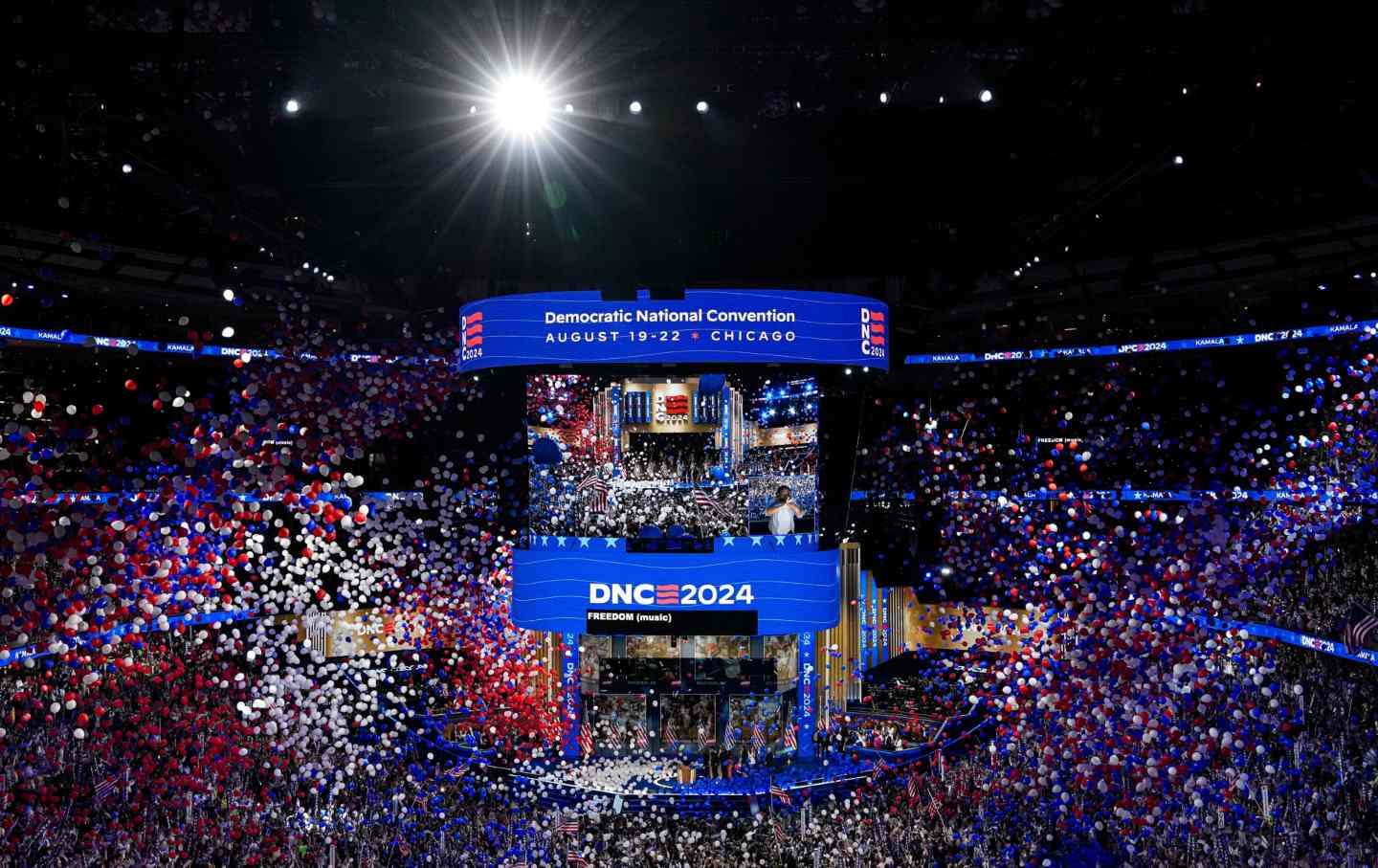
Balloons drop following a speech by Vice President Kamala Harris during the Democratic National Convention at the United Center in Chicago, Illinois, on Thursday, August 22, 2024.
(Al Drago / Bloomberg via Getty Images)
The stakes could not be higher, and yet the Democratic Party is undermining its own chances of winning the midterms. Not for lack of money—there is plenty of money—but because a bias so pervasive that most of the people acting on it cannot see it is shaping how it gets spent. I’ve given that bias a name: Straight White American Male Preference, or SWAMP. It dilutes Democratic strategy, misdirects hundreds of millions of dollars, and starves the constituencies most likely to produce a majority.
My organization, Democracy in Color, has just completed a comprehensive SWAMP audit of the Democratic Party, and the findings are alarming.
It follows in the tradition of the Fannie Lou Hamer Report, the first independent audit of Democratic Party spending, which my late wife, Susan Sandler, Julie Martinez Ortega, and I published in 2014. That report found that, of the $514 million the DNC, DSCC, and DCCC paid to consultants, just 1.7 percent went to firms owned by people of color. Twelve years later, the leadership and the consultant corps have barely changed—and what flows from that is more urgent still: roughly a billion dollars misallocated by preference rather than by data, based on the spending patterns of the most recent election cycles.
A SWAMP audit, a tool I developed while writing my latest book, Are White Men Smarter Than Everybody Else?, measures the racial and gender preference an institution is showing. It rests on a single number: Straight white men are 29 percent of the US population and 29 percent of the electorate. Where white men hold not 29 percent of the power but 67, 89, or 100 percent, only two explanations are available. Either white men are smarter and more deserving than everybody else, or preference is doing the work.
Leadership
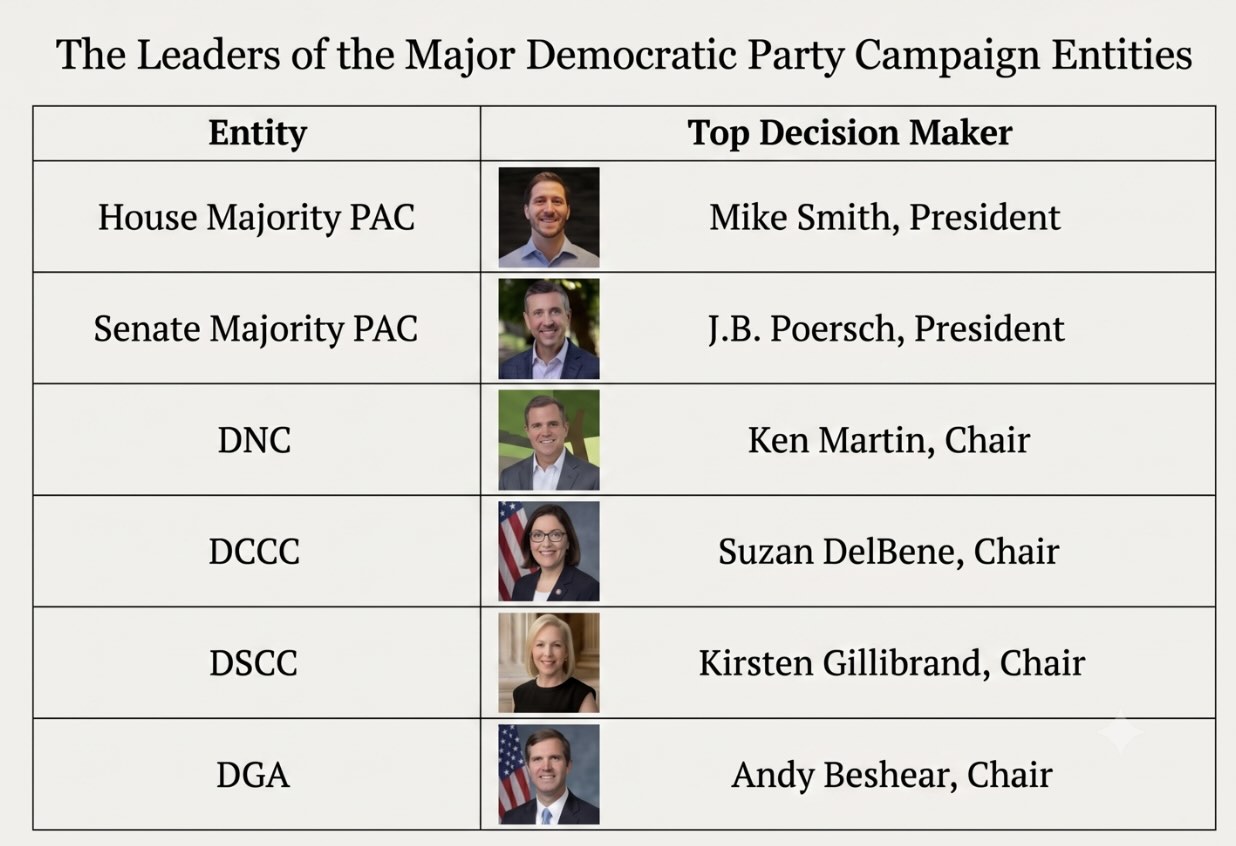
Nearly half of all Democratic voters are people of color. But 100 percent of the top leadership of the party’s principal campaign committees and allied super PACs is white, and 67 percent of those leaders are white men—more than double their share of the country. If expertise about your target constituencies matters—and it does—that absence of cultural insight and a track record is a strategic liability, not merely an equity problem.
Current Issue

This tracks with how power is allocated everywhere in this country, and it reflects the widespread, rarely stated, emotionally uncomfortable assumption that white men are in fact smarter than everyone else. Isabel Wilkerson identified this reality in her book Caste, describing America as a long-running drama in which “for generations, everyone has known who is center stage in the lead.”
It is a truism of behavioral science that people tend to like people like themselves, so it should be no surprise that monochromatic Party leaders turn to other whites, and to white men, in grossly disproportionate numbers. Our analysis of the FEC filings by the top Democratic Party committees found that of the $155 million paid this cycle to the consultants among the party’s top 100 vendors, 89 percent went to firms run by white people, and 57 percent of those firms are run by white men.
Strategy and spending
This is not about abstract racial and gender bean-counting. It’s about winning elections, retaking control of Congress, and stopping the march of authoritarianism in America.
White men are 29 percent of the population and accounted for just 26 percent of the Democratic coalition that won in 2020. In other words, nearly three-quarters of Democratic voters are not white men. The six entities that constitute the party’s spending apparatus deployed $2.3 billion in 2024 and are on course to spend roughly $1 billion in these midterms. That money has to follow the arithmetic of the actual electorate.
It doesn’t. Television advertising is, almost by definition, a tool of persuasion. You don’t need to saturate the Black community with ads about how bad the Republicans are, for example, as 90 percent of Black voters regularly reject the GOP. But most spending is on ads designed to persuade, usually white swing voters. In 2024, those six committees spent $1.1 billion on persuasion advertising and $64 million on field and voter mobilization. For every dollar the party spent mobilizing the voters who are its base, it spent $17.70 chasing the voters least likely to be with us.
That is not just statistical overrepresentation. It’s a foolhardy defiance of the law of diminishing marginal returns: Past the saturation point, additional spending in a market becomes wasteful, because you’ve already attracted all the support that pool of people is going to give you.
Democratic spending on white men blew past that point decades ago. Democrats have not won a majority of white male voters since 1968, and that support has stayed within a narrow band, under a hard ceiling, in every presidential election since 1992 (peaking in 2008 at 40 percent), no matter how many hundreds of millions get thrown at it. And the premium is steep. Political scientists John Sides, Lynn Vavreck, and Christopher Warshaw estimate that television persuasion in Senate contests costs roughly $200 per vote; the mobilization research of Donald Green and Alan Gerber puts the cost of an additional vote through organizing at $65 to $84.
Pennsylvania in 2024 shows what that costs. Democrats lost the Senate race there by roughly 15,000 votes, while 354,000 eligible African American voters did not cast a ballot. Black turnout was 64 percent, against 69 percent among whites; closing that gap would have produced 55,000 votes, roughly 90 percent of them Democratic. At the high end of the Green-Gerber range, $4.7 million in Black voter mobilization would have won the seat. Democrats spent $62 million on television there.
Winning
Here is the good news, and it is considerable: The votes required to win in 2026 already exist. They don’t have to be persuaded. They have to be mobilized.
The Senate map runs through Alaska, North Carolina, Texas, Ohio, Georgia, and Maine—states where women and voters of color, not straight white men, will decide the outcome. Alaska has the largest Native population share of any state, and the Democratic nominee, Mary Peltola, is Alaska Native. Black voters are more than a fifth of North Carolina’s electorate and roughly a third of Georgia’s; they are not a constituency to be appended to the end of a television plan—they are the plan. And every year 4 million young Americans turn 18, most of them people of color.
Popular
“swipe left below to view more authors”Swipe →
We know this works because we have done it. In 2018, a Latino-focused mobilization program anchored by Communities for a New California reached 40,000 voters and unseated Republican David Valadao in California’s two-thirds-Latino 22nd district. In Georgia, eight years of registration and organizing, propelled by Stacey Abrams, delivered Jon Ossoff, Raphael Warnock, and control of the Senate.
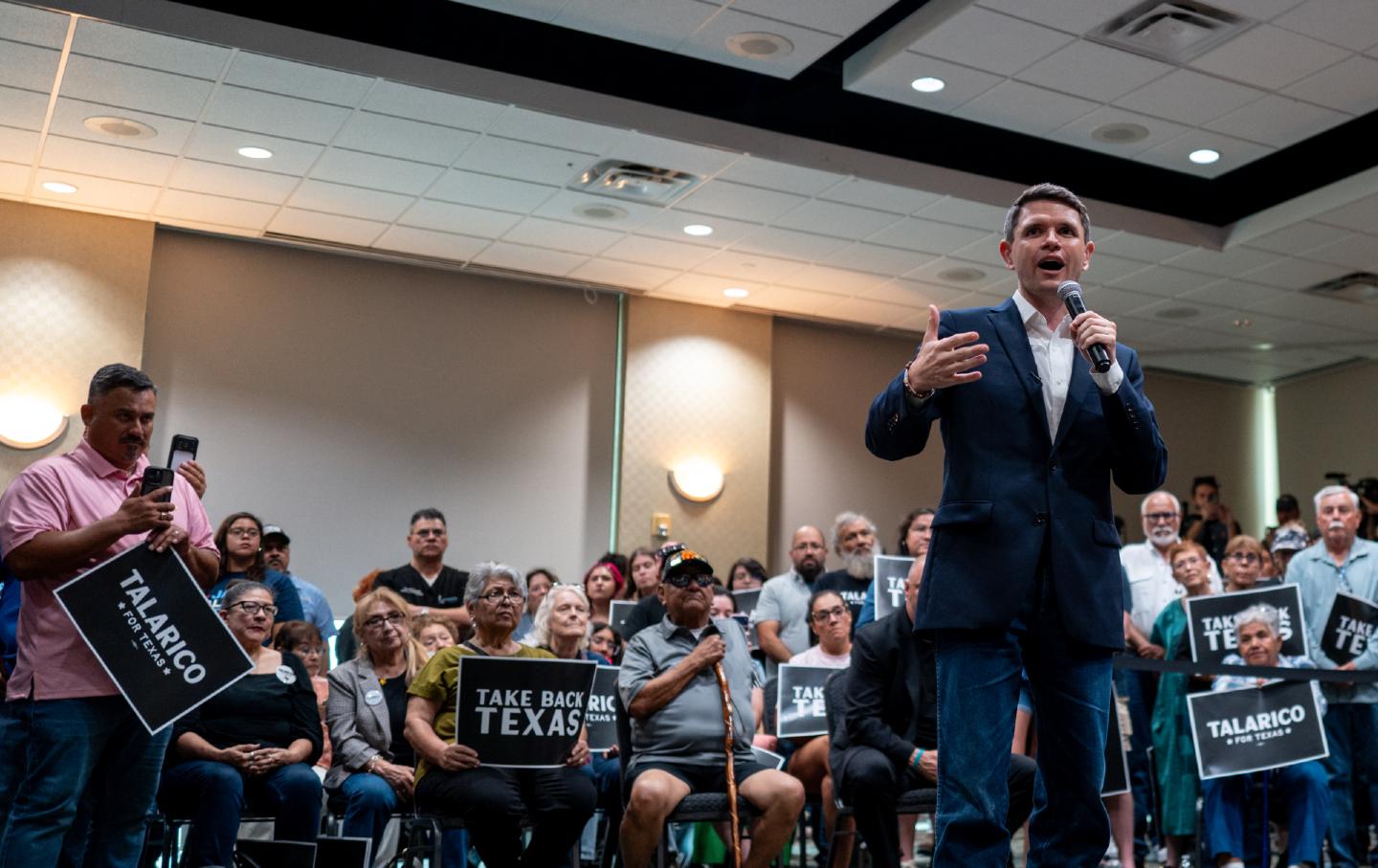
There are signs the party can learn. Two white male Democratic Senate candidates, are modeling how to spend money in ways that target the non-white male majority of the electorate. In Texas, James Talarico’s Senate campaign has announced $25 million for Black voter mobilization, among the largest such commitments any Democratic campaign has ever made. In Georgia, Ossoff has made accountability on the Epstein files a centerpiece of his reelection, and the polling is rewarding him for it. The conventional wisdom that Democrats should say nothing about gender justice is being disproven in real time.
The counterexample is just as instructive. In June, the DCCC, which normally stays out of contested primaries, spent $135,000 opposing Randy Villegas, a Latino Democrat running in a district that is two-thirds Latino. He won anyway.
The remedy is not complicated: De-SWAMP the spending. Of the roughly $1 billion Democrats will deploy this fall, no more than 29 percent should chase straight white men (their share of the electorate) and at least 71 percent (roughly $710 million) should go toward mobilizing the women, people of color, and young people who are the party’s majority and its greatest untapped strength, through permanent, community-based, year-round organizing. And straight white men should not hold way more than 29 percent of the party’s campaign leadership.
Confronted with the overrepresentation this audit documents, there are only two explanations. Either straight white men are smarter and more deserving than everyone else, or preference is doing the work. We reject the first, and this audit is the evidence for the second. There is still time to defeat this disease, win the midterms, and forestall authoritarianism—but only if the party spends as though every vote, and every voter, matters equally.
More from The Nation
More important than fixing production methods is fixing our ill-advised foreign policy.
Trump’s order limiting mail-in voting is patently unconstitutional—but that didn’t stop the court from giving it the green light.
A unique new messaging study underscores the supremacy of economic populism in rural America and beyond.
The Trump administration’s “Donroe” Doctrine promotes a flawed and failed policy of US intervention in the hemisphere.