
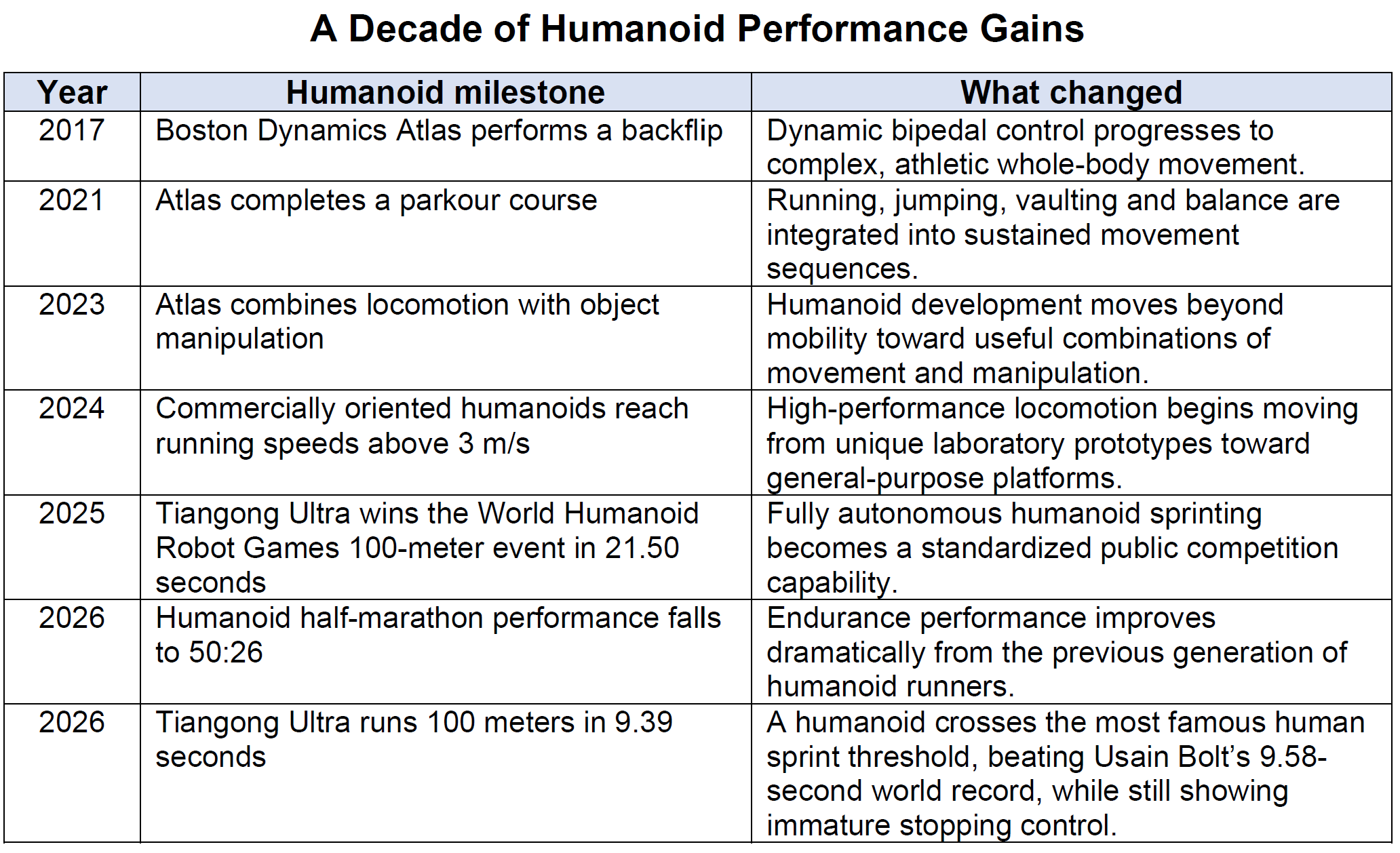
For most of the history of robotics, contests between robots and humans have been entertaining precisely because they were so unequal. Humans could run, jump, balance, improvise, and recover from mistakes with an ease that made even sophisticated robots look awkwardly mechanical. The comparison flattered us.
That capability gap is closing. Recent Chinese humanoid robot competitions provide a particularly vivid demonstration. Humanoid machines are now running, fighting, playing sports, recovering from falls, and performing increasingly complex physical tasks in environments designed for human bodies. A humanoid has already broken Usain Bolt’s Olympic 100-meter performance benchmark. Robotic demonstrations remain uneven, and today’s humanoids are nowhere near ready to replace trained infantry soldiers. But general-purpose machines in approximately human form have entered the long-established range of human physical performance—and their improvement curve is steep.
The second-edition of the World Humanoid Games is under way in China.
The competition, which kicked off on Saturday, will run for five days and has already included a robot running faster than Usain Bolt’s 100m sprint world record. Full story: https://t.co/d6Y9mMggWx pic.twitter.com/TUaZoFQsjH
— BBC News (World) (@BBCWorld) August 23, 2026

The spectacle of a humanoid surpassing a celebrated human athletic threshold is striking. Militarily, however, the important race is not against Usain Bolt. It is against the infantryman. That competition has very different rules. A soldier must move rapidly while carrying equipment, detect and engage targets, negotiate obstacles, operate under stress, communicate with other soldiers, function in darkness and adverse weather, withstand injury, and continue performing amid confusion, terror, and fatigue. Human beings are remarkably capable of doing these things, and armies have spent thousands of years developing institutions for making them do so reliably. But almost every item on that list is also an engineering problem for humanoid robots.
The engineering competitor enjoys one overwhelming advantage: the human body is a finished product. It can be conditioned and trained, but its fundamental performance envelope changes very slowly. The machine is not finished. Its actuators can become stronger, its batteries lighter, its processors faster, its sensors more sensitive, and its software and coordination more capable. A deficient component can be redesigned and replaced; a useful capability can potentially be copied across an entire force.
The relevant question, therefore, is not whether today’s humanoid robots are better soldiers than today’s humans. They plainly are not. The question is what happens when the improvement curves cross. At that point the consequences extend far beyond military procurement. For thousands of years, societies have honored the soldier who advances despite mortal danger. Battlefield courage is rewarded by ceremony, medals, and high status because armies require human beings to overcome one of the most fundamental biological imperatives: the desire to stay alive. A humanoid soldier poses no such problem.
By making the human infantryman obsolete, humanoids could also extinguish the military significance of battlefield courage. The coming change is not only between the human soldier and the robot, but between human valor and machine efficiency. This article examines the practical and cultural consequences of this historic transition in infantry warfare.
Why the Human Infantryman Will Be Obsolete
The case for humanoid infantry does not depend on machines becoming humanlike in every respect. They need only become better at the functions armies require infantry to perform. Once that threshold is crossed, many characteristics that distinguish machines from people become advantages rather than deficiencies.
A mature humanoid soldier could be stronger and faster than a human, carry heavier loads, react more quickly, aim with greater precision, and operate with sensors extending beyond ordinary human vision and hearing. It would not require sleep, food, or water, would not suffer fatigue in the biological sense, and could tolerate environmental conditions that rapidly degrade human performance. Damaged components might be replaceable, and machines designed without the need to protect fragile human tissue could eventually accept levels of acceleration, impact, heat, noise, and physical punishment that no infantryman could survive.
These advantages would matter even if machine intelligence never replicated the full flexibility of human judgment. Infantry combat consists partly of open-ended decisions but also of enormous numbers of recurring tasks: movement, observation, target tracking, navigation, communication, weapon handling, formation keeping, logistics, and execution of tactical procedures. Machines need not become artificial people before they become extraordinarily effective at such functions.
Humanoids need not displace specialized drones, tracked vehicles, or other robotic forms; their particular advantage would be operating in the extensive environments already designed around the human body. They could use human tools and equipment, operate legacy weapons, and function in urban environments without requiring the physical world to be redesigned around them.
From Better Soldiers to Better Units
The greater advantage may emerge not at the level of the individual soldier but at the level of the unit. Human armies spend enormous effort trying to make many separate minds perceive the same situation and act coherently. Information must be reported, interpreted, communicated, and converted into orders, all while soldiers may be frightened, exhausted, distracted, or operating with incomplete knowledge. Radios and digital networks improve this process but do not eliminate the underlying problem: an army is a collection of autonomous human beings attempting to coordinate under extreme stress.
Networked humanoids would operate differently. A target detected by one machine could become available immediately to every relevant machine. Positions, ammunition states, sensor data, routes, and threats could be shared continuously without requiring verbal reports. Tactical assignments could be redistributed as circumstances changed. A unit might behave less like a collection of individual soldiers and more like a distributed combat system whose components share a common operational picture. Network dependence could create vulnerabilities to communications disruption, requiring machine units to retain substantial local autonomy when disconnected from the larger force, but the overall capacity for unit cohesion would likely be far greater than that of current infantry units.
This would alter the meaning of tactical experience. Human armies must train every soldier and develop every unit, while hard-won experience disappears when experienced personnel are killed, wounded, transferred, or retire. A machine force could potentially capture useful tactical learning in software and distribute it quickly across the force. A lesson learned by one formation could become a capability of thousands of machines. Human military competence is accumulated person by person; machine competence can be readily reproduced.
An Army That Does Not Rout
The most profound difference, however, may be psychological. Human beings do not naturally behave like expendable military components. They experience fear, pain, exhaustion, grief, confusion, and the desire to survive. Under sufficient pressure even disciplined formations can break. Much of military organization exists to prevent this: training, leadership, unit cohesion, discipline, ritual, honor, and punishment all help keep soldiers functioning when self-preservation urges them to stop.
A machine army would not need to overcome fear because its soldiers would not experience it. Humanoids could retreat when retreat was tactically appropriate, but they would not flee because the machines beside them had been destroyed. They could hold a position until destruction if doing so served the mission, advance through fire that would paralyze human troops, or accept casualty rates that would render a human formation combat-ineffective long before its physical destruction.
This would change the economics of battlefield attrition. Human casualties impose costs far beyond the loss of military capability. Soldiers represent years of upbringing, education, selection, and training; their deaths devastate families, affect morale, and can alter domestic political support for a war. A destroyed humanoid would represent a financial and logistical loss, perhaps an expensive one, but not a bereavement. Its replacement would come from a production system rather than a recruiting office.
That difference could make machine forces formidable even before they surpass the best human soldiers in every skill. A humanoid need not possess the improvisational brilliance of an experienced infantryman if it compensates through superior sensing, precision, coordination, physical performance, reproducible training, and immunity to fear. The crossover need not produce a perfect robot soldier. It need only produce a machine force that is more effective than the human alternative. Once that occurs, continuing to place human beings in the line of fire becomes progressively harder to justify.
Civilian Robots Join the Military Ranks
The transition to humanoid armies may differ from previous military technological revolutions in one crucial respect: the military may not have to invent the basic technology. Nuclear weapons, ballistic missiles, stealth aircraft, and aircraft carriers required enormous government-directed development programs because there was little civilian reason to build them. Humanoid robots are different. If they become economically useful, civilian markets will finance much of the technological infrastructure required for the humanoid soldier.
The potential market is enormous. Manufacturing, warehousing, construction, mining, agriculture, transportation, disaster response, hazardous-material handling, elder care, and innumerable service occupations all provide incentives to develop machines that can move through environments built for humans and manipulate objects designed for human hands. A useful civilian humanoid must walk without falling, negotiate stairs and obstacles, recognize objects, manipulate tools, navigate unfamiliar environments, recover from errors, operate autonomously for useful periods, and become cheap and reliable enough for mass deployment. Solve those problems for the factory and warehouse, and much of the basic engineering required for the battlefield has already been solved.
The military delta remains substantial. Civilian machines would require ruggedization, military communications, specialized sensors, tactical software, protection, and appropriate payloads. Battlefield autonomy presents problems vastly more difficult than moving boxes around a warehouse: electronic warfare, camouflage, deception, physical damage, communications loss, and an intelligent adversary transform the operating environment. But militaries would be adapting a mature industrial technology rather than developing an exotic technology platform from the beginning.
The Battery Problem
Battery endurance is frequently cited as a fundamental obstacle to practical humanoids. It remains a constraint, but the relevant technological threshold may already have been crossed. Boston Dynamics specifies four hours of typical operation for its production Atlas humanoid, and autonomous battery replacement in less than three minutes. A robot does not need enough stored energy to operate continuously for an extended period any more than a military vehicle needs to operate for days without refueling. A humanoid soldier needs useful endurance between replenishment cycles and a logistics system capable of supplying energy faster than the force consumes it.
Swappable batteries provide such an architecture. Depleted packs can move rearward for charging while fresh packs move forward, with vehicles and mobile generators providing charging capacity. Field endurance therefore need not equal battery endurance. Present civilian humanoids already demonstrate operating times of roughly two to five hours per charge, while commercially available silicon-anode lithium-ion cells have reached specific energies as high as 450 Wh/kg. A military humanoid powered by such an advanced battery could plausibly achieve several hours of strenuous operation—perhaps four to eight hours under less continuous loads—before swapping packs. Higher energy density can alternatively preserve endurance while releasing weight for armor, sensors, ammunition, or other payloads.
Swapping also separates improvements in energy storage from improvements in the humanoid itself. A standardized battery interface allows an existing machine to ride the battery technology curve without redesign. Higher-capacity replacement packs can extend endurance at the same weight, while lighter packs can preserve endurance and increase payload. Battery improvements could therefore propagate through an existing humanoid fleet simply by replacing the packs powering it.
Battlefield energy supply would remain a substantial logistical burden. Batteries must be transported, protected, charged, maintained, and replaced, while the electrical infrastructure supporting them would present vulnerable targets. But human infantry also requires continuous supplies of food and water, along with sleep, shelter, sanitation, medical care, and casualty evacuation. Humanoid forces would not eliminate logistics; they would substitute an electrical and mechanical logistics system for a biological one.
The relevant question is therefore whether batteries can provide useful periods of operation and be exchanged rapidly enough to sustain a force. Existing technology suggests that they can, and thus battery swapping largely solves the individual endurance problem. Humanoid soldiers will benefit from better batteries, but they do not appear to need a battery revolution. The potentially formidable problem of supplying electrical energy to a large machine army will require new logistical arrangements, but their cost will be offset by the corresponding reduction of human logistical burdens.
An Army That Learns Once
Training is one of the largest costs of human military organizations. Soldiers must be individually selected, trained, exercised, and organized into units, while advanced competence develops slowly through experience. Machine competence changes the economics of learning. If research or combat experience reveals a better way to recognize an ambush, negotiate an obstacle, coordinate movement under fire, or respond to a tactical situation, that knowledge need not remain confined to the machine that acquired it. Once validated, it could potentially be distributed rapidly throughout the humanoid force. Training would be replaced by software updating.
A human army must train every soldier. A machine army may only have to learn once. The converse is equally important: a common software defect or exploitable tactical error could propagate just as widely. Machine uniformity would create common-mode vulnerabilities that human variability sometimes prevents. However, human armies have also been guided by shared erroneous doctrines that can be more difficult to correct than software or tactical errors.
The difference becomes especially important under attrition. When a veteran soldier is killed, much of that individual’s accumulated experience disappears. Destroying a humanoid need not destroy what the machine has learned. Combat telemetry from many machines can be aggregated, tactical software revised, and the resulting improvements distributed to surviving machines and newly manufactured replacements. Attrition could therefore produce a striking asymmetry. A human army suffering severe casualties tends to become less experienced. A machine army suffering severe casualties could lose hardware while simultaneously generating data that improves its replacement force.
The Competitive Extinction of Human Infantry
The replacement of human infantry would not require every government to decide independently that humanoid soldiers were desirable. Military competition could make the decision for them. Imagine that one major military power develops humanoid formations substantially superior to human infantry. They move faster, shoot more accurately, coordinate more effectively, tolerate greater environmental extremes, and accept missions too dangerous for human soldiers. Destroyed machines are replaced from factories, while tactical improvements can be propagated throughout the force through software. An adversary continuing to employ human infantry would then suffer two disadvantages simultaneously: its soldiers would be less capable, and their deaths would impose costs that the opposing machine force did not bear.
That is an unstable competitive position. Military history contains many technologies that states adopted not because they welcomed them but because their adversaries possessed them. Once humanoid infantry provides a substantial battlefield advantage, the question changes from Why should we deploy this technology? to Can we afford not to?
The transition would probably be incremental. Machines might first assume particularly dangerous missions such as reconnaissance, breaching, tunnel clearing, urban entry, ammunition resupply, casualty recovery, and occupation of exposed positions, while humans remained behind them to exercise judgment and perform tasks the machines could not. But every successful transfer of a dangerous function to machines would make the remaining human exposure harder to justify. Eventually, sending a person where a machine could perform the mission better might resemble sending cavalry against tanks.
Elite Armies for Sale
Humanoid forces could also revive one of warfare’s oldest institutions in radically new form: the mercenary army. Historically, rulers could substitute wealth for military manpower by hiring soldiers, but the substitution was imperfect. Mercenaries still required recruitment and training, varied in quality, could suffer collapsing morale, and had their own ideas about how much danger an employer’s money justified.
A commercial humanoid force would be a different product. A supplier could potentially sell or lease an integrated military capability comprising machines, tactical software, communications, maintenance, logistics, upgrades, and technical support. Military quality would reside increasingly in an engineered system rather than in the accumulated human capital and institutional traditions of the purchasing state.
This could weaken the ancient relationship between population and land power. A small but wealthy country might purchase tens of thousands of high-quality combatants without conscripting a substantial portion of its population or spending years developing experienced soldiers and officers. Conversely, a populous but poor state could find one of its traditional strategic assets depreciating. The decisive resources would shift toward capital, manufacturing, computing, energy, components, and access to the companies controlling the technology.
More profoundly, humanoid warfare could industrialize the production of military quality. A state can already buy excellent weapons, but it cannot buy an excellent human army off an assembly line. Officers must acquire judgment, soldiers must develop skills, units must train together, and institutional competence must accumulate over time. If much of machine combat competence resides in reproducible hardware and software, however, manufacturing additional combatants need not dilute their average quality. Tactical improvements can be copied, sensors manufactured, and software installed. Industrial production would no longer merely manufacture weapons; it could manufacture competent combatants.
No Way Back
Current humanoids remain far from reliable replacements for infantry under battlefield conditions. Hostile terrain, electronic warfare, mechanical damage, autonomous decision-making, target discrimination, communications loss, and the unpredictability of combat remain formidable problems. But uncertainty about timing should not be confused with uncertainty about the competitive logic.
If machines eventually combine adequate individual capability with superior coordination, reproducible competence, immunity to fear, expendability, and continuing technological improvement, there is no obvious mechanism by which human infantry could regain the advantage. Humans cannot evolve stronger muscles as robotic actuators improve, shorter neurological reaction times as processors become faster, eliminate fear because machines do not experience it, or reproduce decades of experience as readily as software can be copied.
Human infantry might survive for specialized missions, political reasons, or simple institutional inertia, just as cavalry traditions survived the disappearance of mounted warfare. Future generations might watch reenactors wearing body armor, carrying assault rifles, and demonstrating the dangerous craft once practiced by human beings on battlefields. The equipment would be authentic and the courage required to use it still admired. But no sensible army would send them to fight. At that point, an institution much older than any military weapon would begin to disappear: the valiant warrior.
What Was Military Courage For?
The disappearance of human infantry would eliminate more than a category of military employment. It would remove the functional requirement for one of the oldest and most celebrated human virtues: battlefield courage. Courage is usually discussed as a moral quality, but for armies it has always had an intensely practical purpose. Human beings possess a powerful instinct for self-preservation, while warfare repeatedly requires them to act against it: to advance when they may be killed, remain when flight offers a better prospect of survival, expose themselves to protect comrades, and continue functioning while people around them are violently killed.
Military institutions have therefore developed compelling cultural practices for overcoming this biological constraint. Training makes dangerous behavior habitual. Discipline substitutes institutional compulsion for individual choice. Leadership provides authority to follow when fear interferes with judgment. Comradeship makes abandoning a position equivalent to abandoning friends. Patriotism connects personal risk to a larger community, while honor and shame create social consequences for courage and cowardice. Military identity makes willingness to confront danger part of what distinguishes the soldier from the civilian.
Commanders sometimes exploited this mechanism directly by conspicuously sharing the danger they demanded their soldiers confront. Alexander the Great famously exposed himself to extreme personal danger during assaults, making failure to follow him an act not merely of fear but of abandonment and disgrace. The exemplary power of such leadership depended upon shared vulnerability. A humanoid leading human soldiers into lethal fire could not exercise the same moral force. Its advance would demonstrate neither courage nor willingness to share their risk.
These practices are so deeply embedded in military culture that their instrumental function can disappear behind their moral significance. We honor courage because it is admirable, but armies also honor courage because they need it. Medals, heroic stories, regimental traditions, and public ceremonies help convert biologically extraordinary behavior into conduct that a military organization can repeatedly demand. The culture of valor is part of the machinery that makes human warfare possible.

Yet courage acquires heroic significance because accepting danger permits something consequential to be accomplished. Don Quixote’s willingness to charge the windmill does not reflect a lack of physical courage; he accepts what he imagines to be danger. The charge is comic rather than heroic because his courage is disconnected from reality and useful consequence.
Technology can produce a similar inversion. If a dangerous military task can be performed more reliably by a machine, sending a human no longer demonstrates that courage was necessary to accomplish the mission; it demonstrates that a person was unnecessarily exposed to danger. We already accept this principle with explosive-ordnance-disposal robots and uncrewed aircraft. If a machine can clear a minefield, enter a contaminated building, or cross terrain covered by enemy fire, deliberately substituting a vulnerable human requires justification. As the machine advantage grows, avoidable danger can change from a source of distinction into evidence of poor judgment.
Humanoid soldiers would extend this logic to the central figure of ground warfare. Once machines could advance under fire, clear buildings, hold exposed positions, recover casualties, and assault defended terrain more effectively than people, courage would cease to provide the operational advantage that historically made it indispensable.
This would complete a paradox running through the history of warfare. Military civilization has devoted enormous cultural effort to creating people willing to confront mortal danger, while military technology has devoted enormous technical effort to reducing the danger they must confront. Armor protects the body; fortification protects the position; artillery permits killing from farther away; aircraft increase the distance still further; precision weapons and drones increasingly separate the person making the decision from the place where its lethal consequences occur. Humanoid infantry would carry that trajectory to its logical conclusion by removing the vulnerable human body from the immediate battlefield.
Courage itself would not disappear from human affairs or even from military life. Political courage, moral courage, physical courage in emergencies, and difficult decisions under uncertainty would remain. What could disappear is something narrower but culturally enormous: the requirement that a soldier demonstrate virtue by overcoming fear while deliberately facing death. For thousands of years, armies solved the problem of frightened human beings by manufacturing courage. Humanoid armies would solve the same problem by eliminating the frightened human being.
The Machine Warrior: Combat without Heroism
Consider the actions for which soldiers have historically received their highest decorations for valor. A soldier advances through intense enemy fire to attack a position. Another leaves cover to rescue a wounded comrade. A small force holds its ground against overwhelming numbers to protect the withdrawal of others. A mortally wounded soldier continues fighting rather than abandon his position. These acts differ tactically, but their heroic character arises from the same fact: human beings knowingly accept extraordinary personal danger to accomplish something consequential.
A sufficiently capable humanoid could reproduce almost every observable element of this behavior. It could advance through fire, retrieve a disabled machine or wounded human, shield others with its body, continue operating after severe damage, hold a position against overwhelming odds, or undertake a mission certain to result in its destruction. Machines might eventually perform such actions more reliably than the bravest human soldiers because there would be no conflict between tactical requirements and an instinct for self-preservation. If the mission required the machine to advance, it would advance.
Yet describing this behavior as courageous would empty courage of its traditional meaning. Courage requires something to overcome. The heroic soldier knows that death or terrible injury is possible, experiences the impulse to avoid that outcome, and nevertheless chooses to act. The machine performs the dangerous act without confronting that internal conflict. There is no fear to master and no finite human future voluntarily surrendered. The behavior can be identical while the virtue is absent.
The distinction becomes clearest in the traditional last stand. A thousand humanoids could fight with perfect determination until the last machine was disabled, perhaps delaying the enemy more effectively than any human formation could. The military result might be significant, but there would be no legendary heroic Spartans because no person experienced the act as a sacrifice.
This distinction between efficient performance and heroism has consequences for the identity of the warrior. Even elite combat forces would confront this logic. Marines, Rangers, SEALs, and comparable formations occupy a position of high status in military culture because their members combine unusual willingness to accept danger with skills most people do not possess. Mature humanoids would counter both forms of scarcity. Machines require no exceptional willingness to confront danger, while capabilities embodied in hardware and software can potentially be reproduced rather than cultivated through prolonged selection and training. Elite military performance might survive, but the elite warrior need not survive with it.
Valor decorations reveal how thoroughly military culture has institutionalized the relationship between danger and distinction. Medals convert exceptional consequential courage into public status, and their value depends upon scarcity: the recipient did something most people, and often most soldiers, would not or could not do. Humanoid forces dissolve that scarcity. If every machine equipped with the same hardware and software would perform the same dangerous act, there is nothing exceptional about the individual combatant. Heroism is particular; machine performance is reproducible.
Military distinction would not necessarily disappear. Exceptional commanders, engineers, programmers, intelligence analysts, or system designers might acquire enormous prestige because their decisions determine battlefield outcomes. What disappears is the traditional connection between military distinction and the willingness of a particular human body to enter mortal danger. The machine can perform the act for which the soldier once received the medal, perhaps more consistently and effectively, without requiring courage at all. Once that becomes normal, the question is no longer whether machines can behave heroically. It is what becomes of a military culture that no longer needs heroes.
The Drone Operator Medal Test Case
The coming collision between military effectiveness and traditional valor has already had a dress rehearsal. In 2013, the Department of Defense announced the Distinguished Warfare Medal, intended to recognize extraordinary achievements by personnel whose actions could have major combat consequences even though they were physically remote from the battlefield. Drone operators and cyberwarfare personnel were obvious candidates. Modern warfare had created people who could contribute decisively to combat outcomes without confronting the physical danger traditionally associated with combat decorations.
Drone operator in command center – achievement without battlefield exposure

Controversy resulted immediately because the proposed award collided with a status hierarchy deeply embedded in military culture. A drone operator might identify and destroy an important target, protect troops under attack, or contribute more to the outcome of a battle than an infantryman physically present on the ground. Yet veterans and military organizations objected to placing an award for remote achievement above decorations associated with physical exposure to combat. The issue was not whether the remote operator’s contribution could be important, but whether exceptional military effectiveness and battlefield valor were the same kind of achievement.
The Pentagon ultimately abandoned the medal and developed a different solution. Remote combat effects could be recognized with an “R” device attached to an appropriate decoration, while the “V” device identified acts of combat valor. The distinction is revealing: the military found a way to honor consequential remote performance while preserving a separate category for traditional valor.
That solution works as long as humans still occupy the battlefield. Humanoid infantry would destabilize it by transferring the most dangerous actions to machines. The entity entering the building, crossing exposed ground, recovering the casualty, or holding the doomed position might perform an action of enormous military consequence, while the humans responsible for it, commanders, operators, programmers, intelligence analysts, and maintainers, remain somewhere else.
The Distinguished Warfare Medal controversy therefore anticipated a much larger problem. Drone warfare separated the warrior’s body from some battlefield actions; humanoid warfare could remove it from the battlefield almost entirely. The controversy was an early indication that a military culture built around the relationship between danger, courage, achievement, and honor was encountering forms of warfare in which those elements no longer necessarily belong to the same person.
Beyond Battlefield Valor: Three Futures
The disappearance of human warriors would not mean the disappearance of warfare. It could push international conflict in contradictory directions. Removing soldiers from danger would weaken one of warfare’s oldest cultural foundations, the status attached to martial courage, but simultaneously weaken an important political restraint on military action: the prospect that a government’s citizens will be killed. The technological trajectory toward machine combat is reasonably foreseeable; the geopolitical equilibrium that follows it is not. Three very different futures appear plausible.
Robot Armies and Chronic Skirmishing
The first is a world in which warfare becomes easier because it becomes less personally costly. Governments contemplating military action must now consider not only whether an operation will succeed but the political consequences of soldiers returning wounded or dead. Even authoritarian governments incur demographic, institutional, and political costs when they sustain military casualties. Humanoid forces would sharply reduce those costs, allowing governments to probe borders, occupy disputed territory, intervene in civil wars, or protect client regimes while exposing few of their own citizens to danger.
This could produce the paradox of societies becoming less martial while their governments become more willing to fight. Public attachment to warriors, sacrifice, and heroic combat might decline even as limited military operations become more acceptable because they resemble contests among machines rather than national bloodletting. Commercial humanoid forces could amplify the effect by allowing wealthy states to acquire intervention capabilities without maintaining large standing armies. Warfare might become more frequent but remain below thresholds likely to provoke attacks on population centers.
Arms Control and Strategic Stability
The opposite outcome is also possible. States might regard rapidly expandable machine armies as dangerously destabilizing and restrict them before competition becomes unmanageable. Arms control would confront a problem quite different from counting missiles, tanks, or warheads. If humanoid soldiers can be manufactured or purchased at scale, much of a country’s latent combat capacity could reside in factories, warehouses, software repositories, computing infrastructure, and stored robot fleets.
Verification would be difficult. Agreements might restrict autonomous targeting, military software, weapon interfaces, conversion kits, or machines maintained in combat-ready configurations. Requirements for human control might provide another limitation. International debate over autonomous weapons already centers on preserving human judgment and potentially establishing legal prohibitions and restrictions, so the conceptual foundations for such an arms-control regime already exist.
The disappearance of warrior status might reinforce this equilibrium. Societies that no longer organize military prestige around courage under fire could become culturally less receptive to warfare. Military service might increasingly resemble technical administration rather than a privileged arena for demonstrating honor, sacrifice, patriotism, or personal distinction. This would not guarantee peace, but it could weaken one of the ancient cultural mechanisms through which warfare confers prestige.
Escalation to Mass Destruction
The darkest possibility follows from one of the machine army’s greatest tactical advantages: it does not rout. Human armies can often be defeated without being physically destroyed because fear, exhaustion, casualties, and collapsing cohesion eventually make continued resistance impossible. A functioning machine force might instead have to be defeated materially. If destroyed humanoids can be replaced from factories and civilian robot inventories, destroying the machines already on the battlefield may accomplish little more than consuming replaceable hardware.
The logical target set then expands backward through the production system. To stop the machines, attack their ammunition and batteries; to stop replacements, attack transportation and logistics; to prevent additional production, attack factories, electrical generation, communications networks, computing centers, and component suppliers. A war initially made attractive by insulating people from battlefield casualties could therefore migrate from the battlefield into the industrial society sustaining the machines. Humans disappear from the front line only to reappear as workers and inhabitants of the infrastructure required to keep the machine army fighting.
Autonomy could further increase the danger by accelerating the speed and scale at which force is applied. Machine-speed systems could compress the time available for people to recognize that a local engagement is producing consequences neither side intended. The danger is therefore not merely that an autonomous weapon makes the wrong decision, but that interacting automated forces could move a conflict along an escalation pathway faster than human decision-makers can arrest it.
These futures are not mutually exclusive. Limited machine skirmishing might coexist with arms-control agreements among major powers, while sufficiently serious conflicts could still escalate toward attacks on the industrial systems supporting robotic forces. Commercial robotic armament suppliers would complicate all three possibilities by making military capacity more transferable, expandable, and difficult to measure.
The paradox therefore remains unresolved. Humanoid warfare could weaken a cultural incentive for war by eliminating the warrior’s traditional status while simultaneously weakening political restraint by reducing the immediate human cost of armed conflict. Removing people from the battlefield would unquestionably change warfare. There is no reason to assume that it would abolish it.
Conclusion: The Last Brave Soldier
For most of military history, technological progress changed the weapons wielded by soldiers without eliminating the need for soldiers themselves. The spear gave way to the rifle, horses to armored vehicles, and observation balloons to satellites, but someone still had to occupy the ground, enter the building, cross the exposed field, and confront the enemy at close range. The infantryman survived successive technological revolutions because the human body remained an extraordinarily versatile general-purpose combatant.
Humanoid robotics may finally challenge that advantage. Today’s machines are not infantry soldiers, and formidable problems of autonomy, reliability, hostile terrain, electronic warfare, and tactical judgment remain. But the long-term competition is asymmetric. Human beings will not become twice as strong, require half as much sleep, react ten times faster, or acquire twenty years of combat experience by downloading an update. Machines can improve along all these dimensions, while civilian industry may finance much of the underlying technology and factories may eventually mass produce capabilities that human armies must laboriously cultivate in individuals. We cannot know when the performance curves will cross, but we can see which curve has the steeper improvement slope.
When that crossover occurs, military competition will make the consequences difficult to avoid. States that continue sending human soldiers against more capable, reproducible, and expendable machines will incur both a tactical disadvantage and a human cost their opponents have escaped. The infantryman would then follow the cavalryman into obsolescence, not because courage, skill, or tradition had ceased to be admirable, but because they no longer provided the most effective means of accomplishing the military task.
That would not necessarily produce a more peaceful world. Removing soldiers from danger could make governments more willing to initiate limited conflicts even as societies became less culturally martial. Machine armies might encourage chronic skirmishing, stimulate new forms of arms control, or push serious wars toward attacks on the industrial infrastructure that manufactures and sustains them. The disappearance of the warrior would remove neither political ambition nor international conflict; it would change the mechanisms through which they are expressed. Humans might disappear from the immediate battlefield, but not from the political object of war: ultimately it is human societies, not their machines, that adversaries seek to compel.
Obsolescence of human infantry would remove something very old from military civilization. From Achilles and Leonidas to the foot soldiers of modern armies, societies have attached exceptional status to warriors willing to place themselves in mortal danger for consequential purposes. Their courage was celebrated partly because it was rare, but also because armies could not function well without it. Once machines can accomplish the same purposes more effectively without requiring courage at all, that ancient relationship between warfare and valor begins to dissolve.
Perhaps someday the last human infantryman to receive a medal for valor will perform an act every bit as courageous as any of those honored for thousands of years before him. Nothing about the machine age will diminish the feat. What will have changed is that no one will need to do it again. Valor will still be esteemed in other domains, but it will no longer be associated with defying death on the battlefield.
