
1
Our Get German Football News Bundesliga 2026/27 Tactical Previews series now arrives at the German record champions. One year ago, the author arrived at this particular stop on the annual Bundesliga tour and found himself doing something profoundly uncomfortable: defending FC Bayern München. Not the football club, mind you. Nobody needed defending there. The administrative department. In last summer’s Bayern tactical preview, a fairly straightforward team preview somehow morphed into a lengthy examination of Max Eberl’s allegedly disastrous transfer window, Bayern’s allegedly dangerously small squad and the assorted allegedly catastrophic consequences awaiting a club that had failed to sign approximately three-quarters of the players linked with it.
The author looked at all of this, noted that Bayern frequently function perfectly well with smaller squads, pointed out that Luis Díaz appeared worth the money and nevertheless predicted the Rekordmeister to finish first. How brave. How visionary. How exceptionally difficult it must have been to predict Bayern München to win the Bundesliga. How on earth is this year’s piece supposed to distinguish itself from the last one? The author is, like most Bundesliga enthusiasts, irritated. Something else that happens to irritate the author concerns the fact that the broader argument actually aged rather well.
By the time the author returned for Bayern’s January transfer primer, there wasn’t much left to litigate. Bayern were first. Bayern were breaking records. Bayern’s supposedly insufficient squad was pulverizing people. Those who had spent August forecasting collapse probably deserved some of the ridicule coming their way. The piece eventually settled upon the old managerial maxim that nothing really needed fixing because, rather inconveniently for everyone searching for drama, practically nothing was broken.
Then Vincent Kompany’s team went and made the whole exercise absurd.
Sixteen points clear.
122 Bundesliga goals.
DFB-Pokal winners.
Champions League semi-finalists.
At some point, tactical analysis begins to feel less like intellectual inquiry and more like standing beside a large industrial machine with a clipboard. The great challenge confronting Bayern this summer was therefore not rebuilding the German champions. It was resisting the natural human urge to fiddle with something that had just spent ten months flattening practically everything placed in front of it. Michael Olise remains ridiculous. Luis Díaz remains ridiculous from the other side. Harry Kane scored (good God) 61 competitive goals last season.
Everyone may go home.
Except Bayern spent nearly €107m anyway.
Of course they did.
FC Bayern München
And so it is that we return to the “big boys on the block,” except this time there is considerably less need to spend several thousand words litigating whether the people upstairs know what they’re doing. Bayern won everything domestically, retained almost the entire spine, spent heavily on two players who expand Kompany’s options and cleared away several pieces of accumulated squad furniture. The tactical questions are therefore smaller than they are almost everywhere else. The footballing problem for the other 17 clubs remains enormous.
The transfer window is about as straightforward as it gets. Bayern did not need to spend nearly €107m augmenting a squad that leaves many of us wondering if we need to actually play the season. The result is less a new Bayern than a cleaner, deeper and infinitely more irritating version of the previous one. Apologies, Dortmund fans. You received your own adulation-ridden piece. It nevertheless simply isn’t happening for you this year. In the event anyone wishes to skip the “why” portion of this analysis, the author fully understands.
Major personnel shifts, Bayern
Estimated Summer Transfer Balance = -€69.7m
In last year’s preview, Guerreiro earned the designation “Portuguese Swiss Army Knife” after spending preparation appearing just about everywhere Bayern could legally place him. Guerreiro has now left. Apparently Bayern solved this by purchasing a German-American Swiss Army Knife with younger legs. Nathaniel Brown arrived from Eintracht Frankfurt for €50m. Another €50m brought Ismael Saibari from PSV into the fold. Bayern then spent approximately €7m on everyone else, which feels less like squad construction than an admirably efficient accounting department refusing to open another spreadsheet.
Brown represents the only obvious alteration to the strongest XI. The German international arrives as the long-term solution at left-back, where Alphonso Davies continues working his way back toward full fitness. Raphaël Guerreiro’s departure further clears the path. Brown’s speed, intelligence and attacking appetite already make him an excellent fit for Vincent Kompany’s aggressive defensive line. The amusing part is that Kompany has apparently interpreted “left-back” as a very loose contractual suggestion. As Konrad Laimer can attest, that’s really nothing new.
Saibari gives Kompany another high-level option capable of operating throughout the attacking midfield line. His €50m fee strongly suggests that “rotation player” would undersell the intended role. The departures are arguably more important for understanding the rest of the squad. Leon Goretzka’s exit finally removes one long-standing central-midfield variable. Bayern now possess a much cleaner hierarchy around Joshua Kimmich and Aleksandar Pavlović, whose partnership remains the preferred control centre. Just behind them, new FCB No. 8 Tom Bischof should benefit enormously.
Elsewhere, we have the annual sorting of Bayern’s enormous developmental warehouse. Noël Aséko moved to Frankfurt, Jonah Kusi-Asare to Fulham, Maurice Krattenmacher to Elversberg, Lovro Zvonarek to Estrela Amadora, and Armindo Sieb to Los Angeles FC. In the overstaffed goalkeeping department, Alexander Nübel moved to Beşiktaş and Daniel Peretz to Southampton. Yawn. The author is now pleased to move on.
Notes from pre-season, Bayern
Bayern’s preparation began in Wiesbaden with 17 World Cup players still on holiday and enough academy products involved to make detailed tactical analysis mildly irresponsible. The first half was mostly defined by nervous buildup errors and a general sense that several participants had only recently been introduced. The arrival of João Palhinha and Tom Bischof after halftime immediately restored calmer circulation and recognizable structure. Bischof converted the equalizing penalty, seemed to occupy most available midfield spaces simultaneously and began what would become an excellent summer. Four days later came the traditional Rottach-Egern exercise, in which Bayern defeated Kreisklasse opposition 15-0 and everyone agreed to behave as though lessons had been learned. Bischof remained prominent. Nathaniel Brown made his Bayern debut. Beyond that, responsible tactical journalism will now resume.
The Asia tour provided a little more useful information. Against Jeju SK, Bayern monopolized possession but repeatedly discovered that having the ball and controlling what happened after losing it are not necessarily the same thing. Felipe Chávez scored early. Bastian Assomo (16) supplied the 2-1 winner. Jeju repeatedly found transition spaces whenever Bayern’s young structure became stretched. The eventual introduction of Kimmich, Pavlović, Tah, Brown and Díaz restored firmer control, though temperatures above 30 degrees and brutal humidity ensured that the tempo occasionally resembled football being played underwater. The Asia tour continued. Bayern crossed paths with fellow Far East explorers Aston Villa.
Villa finally supplied the first properly Kompany-shaped performance. Bayern pressed the Europa League winners high and sometimes pushed four attackers onto Villa’s last line. Arijon Ibrahimović drifted left rather than remaining fixed as a centre-forward and joined Konrad Laimer in leading the press. Bischof’s excellent free kick created Kim’s opener before Ibrahimović’s diagonal ball helped Luis Díaz score a spectacular second. Most intriguingly, Brown began at left-back and simply moved into Laimer’s attacking position after the Austrian departed. Bayern had purchased a €50m defender and were already experimenting with how many floors of the formation he could legally occupy.
That theme continued against Leipzig in the “Telekom Cup”. The more senior Kimmich-Pavlović midfield restored the familiar central platform. Luis Díaz scored a 13th-minute opener. Leipzig emerged from halftime with considerably more tempo, hit the post, forced Neuer into action, and deservedly equalized. Bayern’s response was wonderfully direct: Pavlović split the defense with a vertical pass and Brown ran onto it before calmly finishing through Maarten Vandevoordt’s legs. Ismael Saibari later marked his debut by creating Musiala’s third. A 3-1 victory gave Bayern a symbolic trophy.
Heidenheim then supplied one final warning before the competitive football began. Bayern twice fell behind against the relegated Bundesliga outfit. Chávez required a direct free kick to provide the first equalizer; Ibrahimović supplied the second from the penalty spot. Then Kompany introduced Kane, Olise, Díaz, Pavlović and several other members of the actual aristocracy after the hour. The match changed immediately. Olise created Díaz’s 3-2 before Brown cut inside from the right to score again and complete a 4-2 victory. By then, describing Brown simply as a left-back had become an increasingly aggressive form of misinformation.
The tactical picture nevertheless remained wonderfully familiar. Bayern were never really searching for a new system. They were waiting for the old machinery to be repopulated. Bischof strengthened his claim as a genuine midfield alternative. Díaz looked immediately dangerous. Saibari began finding his way into the attacking rotation. And Brown spent preparation progressing from left-back to roaming attacker quickly enough that his eventual Supercup start at No. 10 no longer felt especially strange.
The shape had survived the summer.
The personnel merely kept refusing to stay inside it.
Winners from camp, Bayern
Nathaniel Brown, LB/AM
Christ almighty! Do we really have to write another ode to Nathaniel Brown? Unfortunately, what’s covered above at the very least requires an executive summary. Like most writers, however, the author can barely stand repeating himself. Let’s just say he scored a lot from a lot of different areas on the pitch. The German national team’s new left back creates quite the buzz around the Bundesrepublik. He feels precisely right as both a footballer and a person. Our postwar pacifist Bundesrepublik is once again proudly exemplified by another US soldier’s son. Despite having played just one competitive match, Brown has already proved his worth for club. Glory for country comes next.
Positionally, the impressive part of his summer was demonstrating that Kompany can move him several positional lines forward without the football immediately requiring an explanatory pamphlet. Speed, intelligent movement and an excellent feel for vacant space made him particularly effective when arriving rather than standing still. Three consecutive scoring appearances eventually ceased looking like an accident. Bayern bought themselves a left-back and appear to have received several additional positions free of charge. Good on them. Those of us bored by Bayern’s latest perfect transfer coup can just picture him helping the DFB-XI return to glory.
Tom Bischof, CM
Bischof spent much of last season filling in at left-back. Brown’s arrival might finally allow everyone involved to stop doing that. The 21-year-old half of the famous “Aschaffenburg Twin Tandem” looked much more at home in midfield. He entered the chaotic Wiesbaden opener and helped Bayern settle, converted the equalizing penalty and then remained one of the most consistently visible players throughout the early preparation phase. Against Aston Villa, his excellent free kick created Kim’s opening goal before another dead-ball effort forced a strong save.
Bischof repeatedly supplied structure while Bayern’s World Cup contingent returned in installments. His summer never really depended on one spectacular performance. He simply kept looking like someone who belonged in the central rotation. Kimmich and Pavlović remain ahead of him. The gap behind them, however, looks considerably less comfortable than it did in June. Let’s not forget that Bischof can play as an eight, ten, full-back, and…okay that’s enough. Everyone has the author’s full permission to toy around with the FCB XI in their own time.
Aleksandar Pavlović, CM
Pavlović did not need pre-season to establish himself, but preparation provided further evidence that Bayern’s midfield increasingly runs best when he is involved. The fact that he wasn’t hindered by injury like last summer constituted progress in its own right. The 22-year-old repeatedly supplied the progressive action “from the deep”. Pre-season examples abounded. By the Supercup, Pavlović was Bayern’s busiest central midfielder and accumulated more touches than anyone else while repeatedly driving the team’s circulation.
The distinction with Kimmich is becoming increasingly useful. Kimmich dictates and distributes. Pavlović moves, presents, carries rhythm forward and gives Bayern another route through midfield. Not exactly a surprise Winner, then. More a pre-season confirmation that the former ball boy’s place in the strongest XI is no longer especially sentimental. The author, picking up his sardonic tone from the beginning of the piece, would like to personally thank former Bundestrainer Julian Nagelsmann for not deploying the two together in central midfield during the World Cup.
The advantage of having a dominant FCB is supposed to translate to the national team.
Arijon Ibrahimović, CF/LW
Ibrahimović entered preparation as another returning loanee whose precise place in Bayern’s plans remained uncertain. He left it having made himself considerably harder to ignore. The 20-year-old led the line against Aston Villa, drifted intelligently toward the left rather than remaining fixed as a conventional centre-forward and supplied Díaz’s second goal with an excellent diagonal pass. He later converted from the penalty spot against Heidenheim and repeatedly looked comfortable moving between central and wide attacking spaces. Obviously, nobody is confusing him with Kane. Ibrahimović’s summer suggested that he can offer Kompany a different attacking profile while still functioning inside the same fluid structure.
Luis Díaz, LW
Díaz did not require a breakout summer. He merely spent preparation reminding everyone why Bayern’s established attacking hierarchy will remain exceptionally difficult to disturb. The Colombian produced a beautiful finish against Aston Villa, reacted sharply to score against Leipzig and then combined with Olise for the winning goal against Heidenheim. His impact became especially obvious whenever Kompany switched from developmental lineups to the senior attacking group. Possession that had previously looked harmless suddenly began arriving somewhere useful. Occasionally elite attackers make tactics considerably easier to explain.
Losers from camp, Bayern
João Palhinha, DM
Palhinha actually performed useful work during the early preparation phase. He helped settle the second half against Wiesbaden, scored against Rottach-Egern and supplied Assomo’s winner against Jeju. The problem was never really the performances. Max Eberl and Vincent Kompany never made a secret of the fact that Palhinha was one of the returning loanees without an FCB future. Poor Palhinha never got a chance to work as Thomas Tuchel’s ill-begotten “holding six”, something that counted as a genuinely stupid idea anyway. Thank goodness this chapter has drawn to a close.
Sacha Boey, RB
Boey received minutes throughout a preparation heavily affected by absent internationals, including starts while Bayern were still assembling something resembling their senior squad. What did not materialize was a convincing route back toward the first XI. Boey belonged to the same group as Palhinha. Some conciliatory praise from Kompany meant precisely nothing. This particular relic from the Tuchel Era benefits least from Tuchel’s conversion of Konrad Laimer into a right-back. One is happy to close this chapter as well.
Bryan Zaragoza, LW
Sensing a pattern? Eberl publicly grouped Zaragoza with Palhinha and Boey among the players for whom the club sees no future, and the Spaniard was subsequently left off Bayern’s Asia tour entirely. This chapter has now lasted long enough to become faintly absurd. The author kindly requests that he no longer be forced to write another complex transfer article.Unlike Palhinha and Boey, Zaragoza did not even receive the courtesy of spending preparation demonstrating that nothing had changed.
Tactical Supercup scout, Bayern
Bayern’s first competitive match supplied the familiar Kompany reminder that the formation written on the teamsheet is considerably easier to understand than the football occurring inside it. Before proceeding any further, the author will briefly raise the Jamal Musiala issue as it is of some relevance in discussing why Nathaniel Brown received an audition in the No. 10 slot. Understandably, the responsible thing to do here is let that last sentence simply speak for itself. No true German football lover wishes anything but safety and security for Jamal. His football career isn’t what’s on our minds.
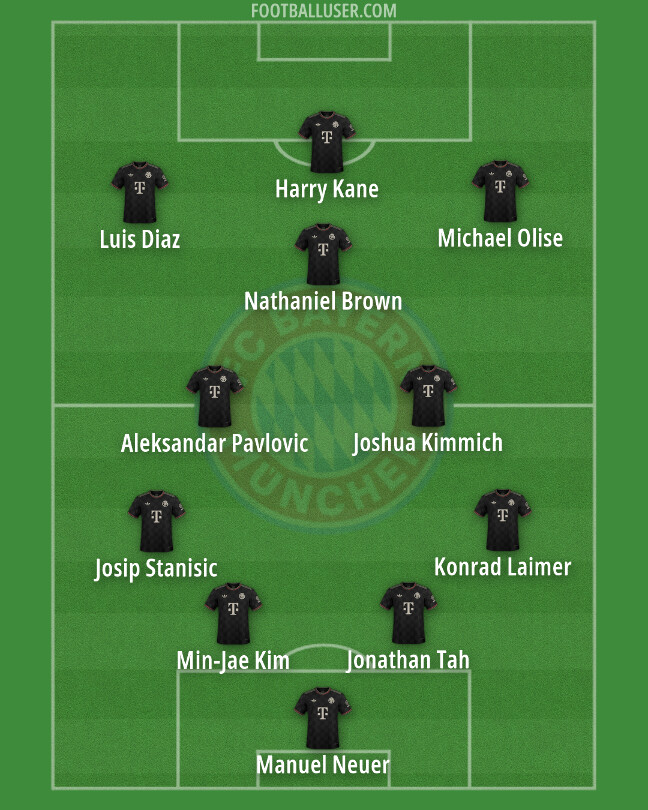
The defending double winners opened the Franz-Beckenbauer-Supercup in their familiar 4-2-3-1. Joshua Kimmich and Aleksandar Pavlović formed the double six, Luis Díaz and Michael Olise occupied the wings and Harry Kane led the line. With Musiala, Serge Gnabry and Lennart Karl unavailable and Ismael Saibari not yet ready to start, Brown began as the No. 10. Calling Brown a No. 10 nevertheless requires one of those enormous tactical asterisks preferably visible from space.
Lineup–FCB (Supercup)

Brown did not interpret the position by remaining behind Kane and requesting the ball between the lines. He roamed according to the movement around him. When Kane dropped toward midfield to participate in buildup, Brown could peel toward the flank or vacate the centre. When Bayern recovered possession and spaces appeared ahead, he attacked them immediately. That dovetailed particularly well with Kane’s own interpretation of centre-forward. The England captain spent much of the opening half hour dropping into midfield to collect possession. Dortmund central defender Waldemar Anton frequently followed him astonishingly deep, sometimes all the way into Bayern territory.
The theoretical Bayern front four therefore looked considerably less rigid in practice. Kane came toward the ball. Brown attacked what Kane vacated. Díaz and Olise stretched and carried around them. Brown’s opener supplied the reward. Olise received around the Dortmund penalty area, protected possession and laid the ball into the arriving Brown’s path. The supposed left-back required little invitation, finishing cleanly from around 16 metres. Brown nearly scored again shortly before halftime.
The early stages were not wholly comfortable. Dortmund pressed with enough aggression to involve Kimmich in repeated duels and occasionally found the flanks themselves. Kimmich later admitted that he considered Bayern insufficiently active in possession and felt the players did not consistently support one another well enough around the ball. Dortmund also generated more danger from crosses than he would have liked. The more important development came as Bayern gradually acquired control through midfield. The central figure was not necessarily Kimmich.
Aleksandar Pavlović accumulated more touches than anyone else and became the principal driver of Bayern’s circulation. He repeatedly demanded possession centrally, moved the ball forward and helped Bayern settle after Dortmund’s energetic opening. Kimmich remained an important distributor but was initially dragged into considerably more physical work than usual. Only later, particularly after the hour, did he begin receiving more freely around Dortmund’s defensive third. That midfield control created the platform for Bayern’s attacking individuality to matter.
Olise was the obvious beneficiary. Dortmund’s inverted left wing-back Julian Ryerson began aggressively enough, but the Frenchman increasingly found ways to isolate and destabilize him. His involvement in Brown’s opener was followed by another dangerous chance and eventually Bayern’s second goal. After Jobe Bellingham surrendered possession shortly before halftime, Olise accelerated through Dortmund’s defensive structure and finished past Kobel.
There is a temptation to describe Bayern’s first half as complete domination. Kompany practically did, calling it close to the “perfect picture” and praising the pressure on the ball, possession dominance and chances his side produced. Kimmich disagreed. The disagreement is interesting. Bayern unquestionably became the better side and deserved their 2-0 advantage. Yet Kimmich correctly identified moments in which Dortmund escaped pressure, received insufficient resistance around crosses and found Bayern’s possession structure less supportive than the scoreline implied.
There was also a useful defensive detail in Bayern’s full-back arrangement. Konrad Laimer started on the right and Josip Stanišić on the left, though the pair temporarily exchanged sides. Neither supplied enormous attacking volume. Much of Laimer’s evening involved running without the ball, while Stanišić’s most incisive offensive contribution came when he lofted an excellent delivery toward Olise shortly before halftime. The second half told a different story.
No immediate Bayern formation change was required. Dortmund changed first, introducing Konstantelias, restoring their wing-backs to their natural sides and accepting substantially more attacking risk. Bayern suddenly had to defend a version of Kovač’s 3-4-2-1 featuring two genuine dribbling creators instead of one. And the previously comfortable defensive picture began developing cracks.
Konstantelias immediately carried the ball at opponents. Karetsas became livelier alongside him. Neuer produced an outstanding reflex save. Jonathan Tah, initially the calmer member of Bayern’s central defensive pairing, had to block a Konstantelias volley and progressively lost some of his earlier security. That second-half deterioration matters because it illustrates a possible vulnerability in Kompany’s approach.
Bayern’s structure works beautifully when the pressure around the ball remains synchronized. When opponents escape the first challenge and attack the back line with runners, the enormous spaces produced by Bayern’s aggressive positioning become considerably less comfortable. The record champs did allow themselves to be rattled in the Supercup’s second 45.
Kimmich’s post-match criticism focused specifically on Bayern’s inability to calm and control the game. Dortmund continued making mistakes that could have been punished, yet Bayern failed to exploit enough of them. Instead of strangling the contest at 2-0, the champions allowed it to become increasingly transitional. That finally produced the 1-2.
Laimer lost security on his flank. Tah then surrendered possession during buildup. Konstantelias moved inward, Svensson overlapped outside him and Fábio Silva finished the resulting cross. It was Dortmund’s goal, but it also exposed Bayern’s second-half issue rather neatly: once their counterpressure failed, Dortmund could attack an unsettled defensive structure with speed.
Alphonso Davies replaced Stanišić shortly beforehand, giving Bayern a fresher and considerably quicker defensive presence on the flank. Structurally, little changed. The substitution was less a system alteration than an attempt to preserve the same framework with different physical qualities. Davies defended his side reliably enough and was unfortunate to deflect Silva’s finish beyond Neuer.
Brown’s eventual replacement by Saibari was similar. The Moroccan entered for the final ten minutes and inherited the central attacking role rather than forcing Bayern into a new formation. The author is pleased to supply another draw-up merely to illustrate that Bayern have another way of thoroughly dominating matches this season.
Lineup–FCB (82nd minute)
Brown’s deployment had looked exotic on paper, but Kompany never needed to construct a special system around him. The 23-year-old simply occupied one of the existing roles in Bayern’s fluid attacking structure and interpreted it according to his own strengths.
Even late on, Bayern still generated opportunities. Kane narrowly missed after Dortmund’s goal, Olise continued carrying into dangerous areas and Saibari tested Kobel in stoppage time. Yet Dortmund also remained capable of hurting them. Silva won an aerial duel against Tah, Neuer nearly created his own catastrophe in possession and Anton eventually threaded Beier clean through for what should have been the equalizer.
So much for “game management.”
The Supercup nevertheless supplied considerably more reassurance than alarm.
The 4-2-3-1 remains Bayern’s reference structure, but—as usual under Kompany—the positional labels are merely starting addresses. Kane drops. Brown rotates. Olise moves inward. The full-backs exchange responsibilities. Pavlović drives possession while Kimmich adjusts his influence according to the spaces available.
Brown’s performance provided the summer’s most intriguing addition to that machinery. His ability to move from full-back into the No. 10 role offers Kompany another Guerreiro-like piece capable of preserving the team’s principles without preserving conventional positional logic. The larger warning came after halftime.
When Bayern pressed well, circulated quickly and supported the ball properly, Dortmund struggled to escape. When those distances widened and the counterpressure weakened, the match became considerably more chaotic than a 2-0 lead should have permitted.
Kompany saw something close to perfection. Kimmich saw plenty still requiring repair. Both assessments rather conveniently fit the evidence. Bayern already look like Bayern. The problem for everyone else is that this remains true even when they are not yet particularly satisfied with how Bayern-like they look.