
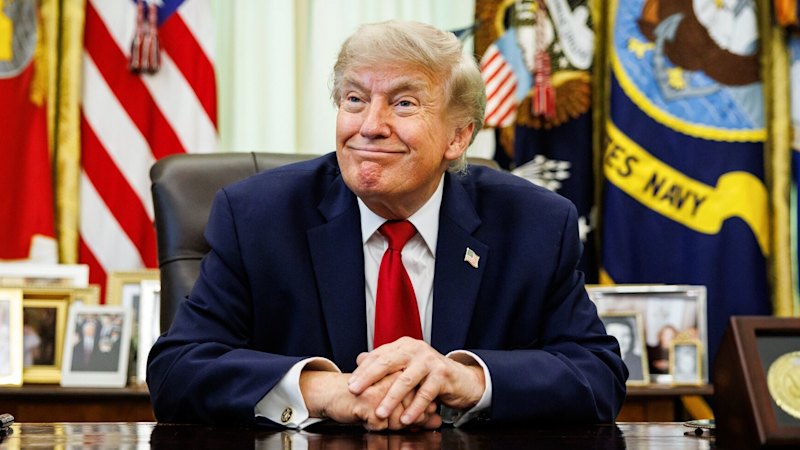

Washington: The United States Supreme Court has struck down President Donald Trump’s executive order to end birthright citizenship, delivering the biggest legal setback to his presidency since it ruled against his tariff regime earlier this year.
But in a major win for the Trump administration, the court allowed states to bar transgender athletes from women’s and girls’ sports, finding that given the inherent physical differences between the sexes, “separate sports teams for biological males and biological females are reasonable”.
The opinions were handed down just before the court’s long summer break, and come one day after a flurry of verdicts on Trump administration matters that will impact presidential power long beyond Trump’s term.
In a split decision, the majority of the bench affirmed birthright citizenship, determining: “Citizenship, then and now, was the right to have rights – to freely participate in our political community. The Framers of the Fourteenth Amendment extended that promise to ‘every free-born person in this land’.”
The first sentence of the 14th Amendment to the US Constitution states: “All persons born or naturalised in the United States, and subject to the jurisdiction thereof, are citizens of the United States and of the State wherein they reside.”
One of Trump’s first acts on January 20, 2025 – the day he took office – was to sign an executive order stipulating that citizenship should not be recognised if a baby’s mother was unlawfully present in the US at the time of the birth, and the father was not a citizen or permanent resident.
Citizenship would also not be recognised if the mother was legally but temporarily in the US at the time of the birth, and the father was not a citizen or permanent resident.
But the court noted that none of these words or concepts were found in the 14th Amendment. “For a simple reason: they did not matter,” the majority found.
“If Congress intended to limit American citizenship to the children of those domiciled in the United States, nothing in the succinct language of the Citizenship Clause conveyed that design.”
The bench was split, and not strictly along ideological lines. Chief Justice John Roberts – a conservative judge nominated by Republican president George W. Bush – wrote the majority opinion, and was joined by the three liberal justices along with Trump appointee Amy Coney Barrett.
Brett Kavanaugh, a conservative appointed by Trump, found the president’s executive order did not breach the Constitution but contravened a federal law that could yet be changed.
The other conservative judges dissented entirely. Clarence Thomas, the second longest-serving Supreme Court justice in US history, said the 14th Amendment was enacted after the Civil War to secure the rights of former slaves, not “foreign birth tourists and illegal aliens”. He said in his dissent: “I am not sure that today’s opinion will stand the test of time.”
Trump had already foreshadowed that he expected the court to rule against him. In a social media post, he said the verdict was “bad for our country”, but birthright citizenship could still be dismantled through legislation rather than executive order.
“Congress should start TODAY to work on ending expensive and unfair to our Country, Birthright Citizenship. They will have my Complete and Total Support!” he said.
In a later post, Trump portrayed the court’s decision as a victory for China. The administration argued in court that companies were helping Chinese elites – among others – to enter the US to give birth, so their child would gain US citizenship.
“I would like to congratulate President Xi, and the Great Country of China, on their massive Birthright Citizenship WIN!” Trump wrote on Tuesday (Washington time).
While some politicians and pundits have quoted far higher figures, the Centre for Immigration Studies – which advocates for low immigration – attributes about 20-26,000 births a year to birth tourism.
Immigration reform has been a focus of Trump’s second term, including closing the country’s southern border and deporting millions of people he says are living in the US illegally.
Despite its 6-3 conservative majority frequently finding in Trump’s favour, the Supreme Court has been one of the major handbrakes on the president’s agenda – most notably when it struck down his so-called “reciprocal tariffs” in February.
But the court handed him a significant win on Tuesday (US time) by siding with West Virginia in a case brought by the family of a biologically male transgender girl who wished to compete in the girls’ athletics teams at her school.
The majority ruled that anti-discrimination law – specifically, one from 1972 called Title IX – did not prevent schools from limiting sports teams to biological females, which they said was a reasonable line to draw.
“Given the inherent physical differences between the sexes, allowing only biological females to play on women’s and girls’ teams can reduce the risk of physical injury and ensure fair competition,” the majority wrote.
There was insufficient medical evidence to claim – as the plaintiffs did – that at least some biological males who took puberty blockers no longer retained physical advantages over biological females, the court found.
The ruling affirms laws banning transgender athletes from women’s sport in 27 US states, and will potentially influence governments and sporting bodies internationally as they grapple with similar issues.
Riley Gaines, a former college swimmer turned conservative activist who campaigns against the inclusion of transgender women in women’s sports, said the law of the land “now reflects reality and common sense”.
Not all agreed. One of the most senior Democrats to speak out against the decision was 2024 vice presidential candidate Tim Walz, the governor of Minnesota, whose state allows transgender participation.
“As the Supreme Court says states can be cruel to trans kids, my message is clear: Here in Minnesota, we stand with and value our trans neighbours and youth,” he said.
Get a note directly from our foreign correspondents on what’s making headlines around the world. Sign up for our weekly What in the World newsletter.
 Michael Koziol is the North America correspondent for The Age and Sydney Morning Herald. He is a former Sydney editor, Sun-Herald deputy editor and a federal political reporter in Canberra.Connect via X or email.