For three years the Von der Leyen Commission has been secretly negotiating to hand over its citizens’ data to a state committing multiple genocides.
Tel Aviv may have lost the hearts and minds of the vast majority of people in the so-called “collective West” a long time ago, but it can still count on the support, however reluctant, of most of their governments.
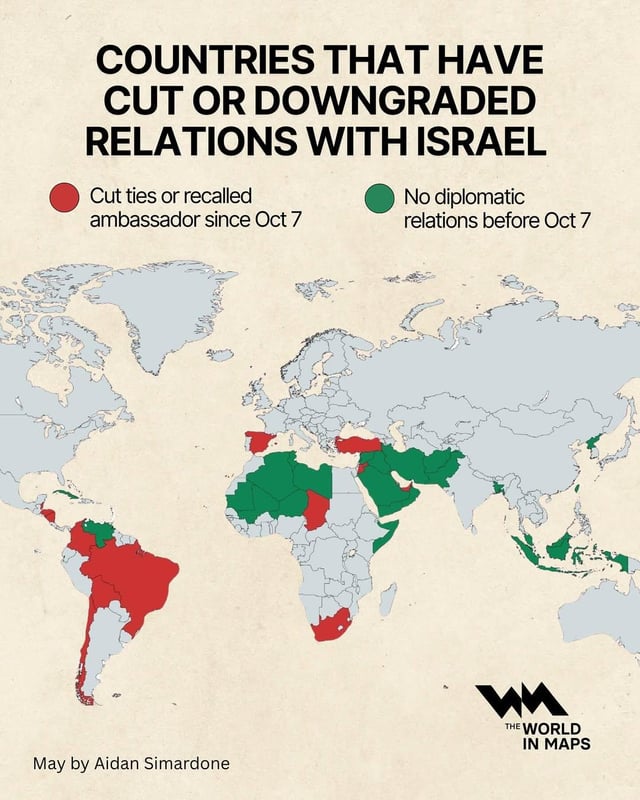
Since the ongoing genocide in Gaza began almost three years ago, only a tiny handful of nations have cut or downgraded their relations with Israel. Some of those countries (Colombia, Honduras, Chile and Bolivia) have since reversed course following a change of government.

Public support for Israel in Western Europe is now at its lowest point ever, according to a recent YouGov poll. Fewer than a fifth of respondents in the six countries polled still hold a favourable view of the country.
Earlier this year, over a million EU citizens signed a petition calling for the suspension of the EU-Israel Association Agreement via a European Citizens’ Initiative. In April, the governments of Spain, Slovenia and Ireland proposed to suspend the association agreement. That was enough to force the EU Council to at least pretend to consider the idea before the governments of Germany and Italy poured cold water all over it.
As a result, billions of dollars worth of trade, much of it military gear and tech, continues to flow between the Jewish State and the EU, Israel’s biggest trade partner, each month. Meanwhile, the lack of any real consequences for its ever-growing roster of war crimes in Gaza means that Israel has felt free to further expand its genocidal campaign.
In Southern Lebanon an estimated 20% of the region’s farmland and forests have been destroyed and 270,000 residents displaced, according to a recent FT report. As Shaiel Ben-Ephraim notes, “this is stated policy and an intentional plan to make an entire area uninhabitable and never allow the population to return.”
Israel is now doing much the same in the West Bank. In recent days, the Netanyahu government, with Finance Minister Bezalel Smotrich reportedly in the driving seat, has opened tenders for the construction of some 1,200 settlement homes in East Jerusalem — a hugely provocative move even by Tel Aviv’s recent standards.
Smotrich is rapidly expanding Israeli settlements in the West Bank, during his last months in office as Minister of Finance, co-Minister of Defence and Governor of the West Bank Civil Administration (yes, he is holding all of these titles) https://t.co/0NQWpUEMVE
— Andrey X (@the_andrey_x) August 20, 2026
THIS IS FUCKING HORRIFIC.
You won’t believe what Israeli bulldozers are doing to the West Bank.
They keep destroying entire roads and infrastructure on purpose.
Israel wants to make life impossible so Palestinians have no choice but to leave. pic.twitter.com/hoUDoJ4wVA
— Parody Jeff (@Parodyjeffx) August 14, 2026
It’s not just violence: Israel is crushing the Palestinian economy too https://t.co/e7r821m7Oh
— Haaretz.com (@haaretzcom) August 20, 2026
As the settlers’ attacks on targets in the West Bank grow in both scale and ferocity, the governments of the West have found themselves in the embarrassing position of having no one but Israel to blame — in the West Bank there is no Hamas or Hezbollah to scapegoat. Their response this week was to sign a joint statement feigning anger about the rising violence while doing absolutely nothing to stop it.
Typical impotence from the EU, UK and Canada:
Hi Israel: we know we buy all your weapons and give you what you want and we always will.
We have to say we don’t really like the aggression in the West Bank and would like you to stop but won’t do anything when you continue.♥️🇮🇱 https://t.co/abOeYKL58m
— Glenn Greenwald (@ggreenwald) August 20, 2026
In March, a group of United Nations experts warned that the genocide in Gaza is bleeding into the West Bank, as violence and Israeli military operations escalate across the Israeli-occupied Palestinian territories.
“Under the cover of an existential war against the Palestinians, Israel is accelerating measures that alter Jerusalem’s demographic composition, religious character and legal status, destroying the remnants of the pluralistic fabric that Jerusalem has represented for centuries, for Muslims, Christians and Jews,” the experts said, adding,
Yet the EU can’t even reach consensus on imposing full trade sanctions on illegal settlements in the occupied West Bank, an area in which it has invested billions of euros over the past few decades but which is now under constant attack by state-sponsored terrorist invaders.
The Ultimate Betrayal
But Brussels is not just sitting on its hands as this all plays out. According to an exclusive report by EU Observer and State Watch, the EU’s Von der Leyen Commission has been secretly negotiating a deal that would allow the wholesale transfer of sensitive personal data from EU systems to Israeli authorities.
That data would apparently include the biometric information, genetic data, location tracking, political opinions, health information and trade union affiliations of EU citizens. The agreement would operate through Europol, the EU’s policing agency, and the data would be available to Israel’s National Police and internal security service, Shin Bet.
The proposed agreement would represent a huge step up from a 2018 deal that explicitly ruled out personal data sharing and explicitly excluded the occupied Palestinian territories. This version includes both.
The negotiations have continued until now, throughout Israel’s genocide in Gaza. This is despite a warning from the EU Council’s legal advisors in late 2022 — almost a year before that genocide began — that allowing data to be used in the occupied Palestinian territories risked legitimising Israel’s occupation of Palestine and would be in breach of international law.
Keep in mind that the EU has run a mission in the West Bank to support the Palestinian Authority with policing since 2005. If the data sharing agreement goes ahead, the data collected by EU police missions operating in the West Bank and the Gaza Strip city and Rafah could be fed into Israel’s existing military surveillance systems.
The really twisted part, as Deaglan O’Mulrooney notes in an article for Washington University’s The Spectacle Mag, is that the EU’s own legal service declared the agreement unlawful in 2022. The Commission, in time-honoured fashion, carried on regardless:
The Council Legal Service concluded that the Commission had breached its negotiating mandate, violated EU treaty requirements, and failed to consult the relevant working group. The lawyers specifically objected to provisions that would allow data shared with Israel to be used in the occupied Palestinian territories, warning it would be the first time an international agreement between the EU and Israel would provide for its application to the territories occupied since 1967, and that it would violate the Palestinian people’s right to self-determination and breach international law. The Commission read all of this, noted it, and continued negotiating anyway.
The agreement was formally frozen in late 2022 following the legal objections. What Statewatch’s investigation reveals is that it did not stay frozen. Commission officials held at least seven meetings with Israeli diplomats between January 2023 and January 2026, including one with Israel’s then-foreign minister Eli Cohen in April 2023. When Statewatch asked the Commission about the current status of the negotiations, it refused to comment. When asked whether it had prepared a revised draft addressing the legal objections, it declined to answer. The Israeli embassy, foreign ministry, and police also declined to respond. Europol, for its part, described itself as a ‘passive observer’ in the negotiations while simultaneously hosting at least five Israeli delegations between August 2024 and March 2026, with meetings facilitated by Israel’s liaison officer to Europol and culminating in a visit from the Israeli ambassador to the Netherlands to Europol’s headquarters in The Hague in March of this year.
“The data transferred via the agreement could be used as intelligence to support decisions to attack and kill Palestinians,” legal expert Eitan Diamond told Statewatch. “The EU would run the risk of arbitrarily depriving people of their freedom and subjecting them to systematic ill-treatment under hellish conditions in detention.”
Conditions like these…
The use of trained rape dogs in Israeli prisons is so well-documented at this point that there is no valid reason to doubt it is happening. All the hasbarists can say is “It’s crazy to think Israel would do something so evil!” Which nobody who’s been paying attention believes. https://t.co/hJjHd7K3go
— Caitlin Johnstone (@caitoz) April 18, 2026
Itamar Ben-Gvir unveiled the construction site where Israel plans to hang Palestinians convicted of terrorism.
It will include a death row wing, with gallows at its centre and viewing areas allowing victims’ families to witness executions – a practice Ben-Gvir said was… pic.twitter.com/pZ3PDENroV
— The Telegraph (@Telegraph) August 19, 2026
Did you think Epstein’s island was bad?
Israel built the world’s only military prison for children, where non-Jewish children are reportedly subjected to abuse.
Conviction rates in these courts reportedly reach 99.7%. pic.twitter.com/3K7PXSLgNy
— GBC (@GBC_Press) August 18, 2026
A number of experts interviewed for the investigation by State Watch and EU Observer warned that the agreement could further expose both Palestinians and Israelis to state-sanctioned human rights violations.
The Commission continued to negotiate the deal even after the ICJ’s July 2024 advisory opinion concluded that Israel must cease its unlawful presence in the occupied Palestinian territories as swiftly as possible. As O’Mulrooney notes, all states and international organisations were instructed to avoid any action that could help maintain that unlawful presence:
The proposed agreement would do precisely the opposite, enabling Israeli security forces to operate more effectively across the occupied territories using data provided by European institutions. The Commission has known this. It has continued negotiating regardless…
Douwe Korff, a legal scholar at Yale University, described it as deeply concerning that the Commission appeared to be moving towards sharing sensitive data about people across the EU, including all their communications with aid workers, officials, and journalists in Israel and the occupied territories, with a state that has carried out targeted killings of children, aid workers, and journalists on an unprecedented scale and is credibly accused of genocide.
In July 2026, 27 MEPs finally submitted written questions about the negotiations. Mounir Satouri, a French Green MEP, said “we are facing a double scandal” because of the “serious violations of international humanitarian law in Gaza” and the “utmost secrecy, shielded from parliament’s scrutiny” in which this deal is being negotiated.
Negotiations, he added, must be suspended immediately. “The commission has disgraced itself by conducting them.”
WTF Happened to GDPR?
This is one of the many pertinent questions that have arisen in the wake of Statewatch’s revelations. The European Commission said any agreement would “contain safeguards protecting fundamental rights, including data protection safeguards, such as restrictions on the use of data in connection with the death penalty”.
That assurance is worth nothing. Any data protection safeguards would be meaningless in the hands of the Israeli police force and Shin Bet. As Novara Media points out, it’s not just Palestinian citizens who could be targeted as a result of this deal; so, too, could journalists and pro-Palestine and anti-war activists in Europe.
This is all happening at a time when EU institutions are building up ever larger databases on EU citizens, linking up national security authorities with Europol while at the same time expanding the technical possibilities for biometric identification and automated data analysis. As we reported just a few months ago, the EU’s digital gulag is close to completion.
And Israel is not the only country with which Brussels is negotiating a comprehensive data sharing agreement. It has also been negotiating a deal with the United States to exchange information for security screenings and identity verification related to border procedures and visa application.
Negotiations for that deal began in 2022, when the Biden Administration offered to share the biometric data of US citizens — in many cases harvested without the consent of the citizens in question — with all 40 countries selected for the US government’s Visa Waiver Program (VWP), which include 23 EU Member States. On one proviso: that those countries reciprocated.
This, one assumes, is how digital public infrastructure like digital identity and central bank digital currencies will become interoperable across international borders. While the negotiations between the US and the EU have been conducted somewhat more openly, the EU Commission’s current proposal still “manifestly violates EU law”, Statewatch reported in May:
It goes much further than their limited mandate for negotiation granted by the Council of the EU and against essential data protection safeguards set out by the European Data Protection Authorities. Anyone’s data exchanged under this proposed agreement could be used for a wide range of purposes. This includes preventing or arresting people travelling to the USA who have voiced opposition to US policies in Europe, or for automated discriminatory profiling of travellers, including EU citizens.
The EU has until December 31 to agree to Washington’s demands to open their biometric databases to US border officials. Otherwise, they could lose visa-free travel to the US. Given how the Trump administration is increasingly using visas as a weapon, revoking or restricting travel and student visas to exert geopolitical pressure, punishing critics and rewarding allies, that may not be such a bad thing.
Meanwhile, the EU’s secret plan to hand over EU citizen’s data to a state committing multiple genocides still remains largely secret — thanks to the fact that most European media outlets have responded to Statewatch’s revelations by studiously ignoring them.
The Von der Leyen Commission would much prefer it if everybody else did the same. As O’Mulrooney notes, “the Commission ignored its lawyers. It ignored the ICJ. It ignored its parliament. It kept meeting, kept negotiating, kept refusing to comment, and hoped nobody would notice.”
“Statewatch noticed. Now you have too.”