
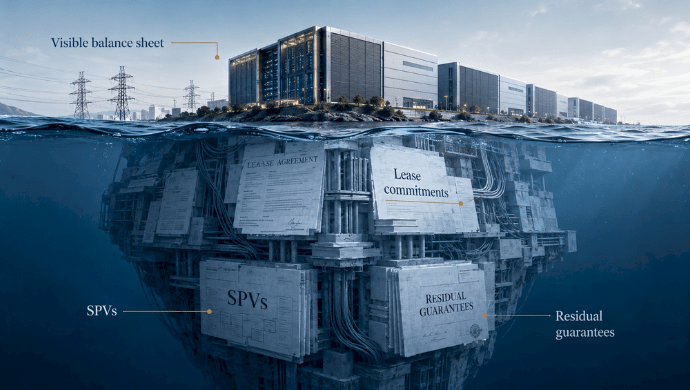
The largest AI companies are building the most expensive infrastructure programme in corporate history.
They are also moving a growing share of the financing away from their own balance sheets.
That does not mean the risk has disappeared. It means the risk has moved.
The new AI financing stack is built from joint ventures, special-purpose vehicles, lease-backs, private-credit structures and residual-value guarantees. These are not inherently abusive structures. They are standard tools of modern infrastructure finance. The problem is not that the accounting is fake. The problem is that the economic exposure is easy to misread.
The phrase “off balance sheet” suggests distance. In AI infrastructure, that distance is often thinner than it looks.
The better question is not where the debt sits legally. It is who has to keep paying if the assets lose value faster than expected, if demand arrives slower than expected, or if a key intermediary cannot perform.
By that test, the sector is becoming more interconnected than the headline balance sheets show.
Moody’s has estimated that the five largest hyperscalers — Amazon, Alphabet, Meta, Microsoft and Oracle — carried roughly US$969 billion of total future lease commitments at the end of 2025. Around US$662 billion of those commitments were for leases not yet commenced and therefore not yet on balance sheets under GAAP.
That US$662 billion is not “hidden debt” in the crude sense. It is not-yet-recognised lease exposure. The companies have not yet received the service that triggers recognition.
But that distinction does not make it irrelevant. It means the liability is delayed, not gone.
A separate Financial Times analysis found more than US$120 billion of data-centre spending had been moved off balance sheets through SPVs in roughly eighteen months, involving names including Meta, Oracle, xAI and CoreWeave.
Those numbers measure different things. The US$662 billion is future lease commitments not yet commenced. The US$120 billion is spending routed through SPVs. Residual-value guarantees are a third category again.
Keeping those distinctions clear matters. Conflating them produces a frightening number no filing supports. Ignoring them produces the opposite error: treating real economic obligations as if they vanish because the accounting recognition comes later.
Meta’s Hyperion structure shows how the mechanism works.
Meta and funds managed by Blue Owl created a joint venture to build and own the Hyperion data-centre campus in Louisiana. Blue Owl-managed funds hold 80 per cent. Meta retains 20 per cent. The JV owns the campus. Meta leases the capacity once built.
A vehicle named Beignet Investor raised roughly US$27.3 billion in debt. Because Meta does not control the vehicle, it does not consolidate the debt. The construction debt sits outside Meta’s balance sheet. Meta instead recognises lease obligations as the leases commence.
That is the legal form.
Also Read: Most AI pilots die in week six. Here’s what LinqAlpha does differently
The economic form is more complicated. Meta’s 10-K reports residual-value guarantees with an aggregate threshold of about US$28 billion. The threshold declines over time. Any payment would depend on the shortfall between fair value and the threshold. Meta also states that payment was not probable at year-end 2025, so no liability was recorded.
That is not an automatic US$28 billion liability. It is capped, contingent and declining.
But it is not cosmetic.
The point of the guarantee is to make a short-life AI infrastructure asset financeable. A normal warehouse can be financed on long residual-value assumptions. A GPU-heavy data centre is different. Its value depends on hardware that can be made obsolete by the next cycle of chips.
That is the new risk inside AI infrastructure finance: not only that the borrower may struggle, but that the collateral itself may deflate faster than the financing assumes.
This is where AI data centres differ from toll roads, warehouses or power plants. The useful economic value of the asset is tied to compute hardware on a rapid improvement curve. A 2026-vintage GPU may still function in 2029. But if newer hardware delivers far more compute per dollar and per watt, the economic value of the old hall can fall quickly.
That is why lease terms have shortened. Investors do not want to underwrite fifteen-year residual values against hardware that may be commercially obsolete in four years. So they demand shorter leases, stronger tenants, and guarantees.
The structure moves construction debt away from the sponsor’s balance sheet. But the risk that the assets depreciate too fast comes back through lease economics, residual-value guarantees, refinancing pressure, or sponsor support.
That is the contradiction at the centre of the AI buildout. The industry is financing today’s compute assets while investing aggressively to make those same assets less valuable.
Nvidia’s economics explain why. It reported a Q1 FY2027 gross margin of 74.9 per cent on revenue of US$81.6 billion. Those margins are the prize every large buyer wants to compete away. Alphabet has TPUs. Amazon has Trainium. Microsoft has Maia. Meta has MTIA. The point of those programmes is to reduce dependence on Nvidia and lower the cost of AI compute.
If they succeed, the cost of computing falls. That is good for AI adoption. It is also bad for the residual value of today’s financed GPU assets.
If they fail, the sector remains more dependent on expensive Nvidia hardware, which pressures the economics of companies leasing that hardware.
Either way, the financing stack is sensitive.
Also Read: How creativity, commerce and AI collide in mid-2026 marketing mix
The other side of the risk is revenue. If AI demand grows fast enough and utilisation remains high, the structures work. Leases commence. Cash flows arrive. Guarantees never trigger. Older GPUs find secondary uses. Analysts see the exposure in the footnotes and adjust gradually. There is no crisis.
That is a plausible outcome, especially for the strongest hyperscalers.
Microsoft remains one of only two US corporates rated AAA/Aaa. Meta sits at Aa3. Amazon remains highly rated. These companies have advertising, software and cloud cash flows large enough to absorb lease obligations as they appear.
For them, the issue is not immediate solvency. It is conditional exposure.
Oracle is different.
Oracle is the natural experiment because it has leaned heavily into AI infrastructure financing while already carrying a weaker credit position. Its FY2026 results show both the promise and the stress. Revenue reached US$67.4 billion. Operating cash flow rose to US$32.0 billion. Remaining performance obligations reached US$638 billion, up 363 per cent year over year.
But free cash flow was negative US$23.7 billion as Oracle funded the cloud buildout. It raised US$43 billion of debt and US$5 billion of equity in fiscal 2026 and expects roughly US$40 billion more financing in fiscal 2027, including a previously announced US$20 billion equity programme.
The market is not ignoring this. Oracle carries BBB/Baa2 ratings with negative outlooks from Moody’s and S&P, and its five-year CDS reached a record near 198 basis points.
That is a useful signal. The market is not a pricing structure alone. It is pricing cash generation, backlog quality, customer concentration and financing need.
Oracle’s defence is also important. It disclosed that prepaid and customer-supplied hardware portions of large AI contracts now total US$75 billion. That reduces the capital Oracle has to raise itself. The bearish version of the story skips that mitigant.
But the basic point remains: SPVs do not protect a company if the underlying cash math is stretched.
The weaker layer is not only the hyperscalers. It is the intermediaries financed against the same chips.
CoreWeave is the clearest case. Its FY2025 10-K showed revenue of US$5.1 billion, remaining performance obligations of US$60.7 billion, a net loss of US$1.2 billion, and 67 per cent of revenue from one customer, Microsoft. By the first quarter of 2026, it had about US$24.9 billion of debt before lease liabilities and US$50.8 billion of total liabilities.
The dependency runs both ways. Nvidia signed a US$6.3 billion take-or-pay backstop on CoreWeave’s unsold capacity through April 2032 and made a US$2 billion equity investment. If CoreWeave stumbled, the parties with operational reason to prevent disorderly failure would include its dominant customer, Microsoft, and its supplier, shareholder and backstop provider, Nvidia.
Google has already written similar step-in logic into project documents.
It backstopped US$1.4 billion of Fluidstack’s lease obligations to Cipher Mining in exchange for warrants representing about 5.4 per cent of Cipher. Later reporting put total Google support to Cipher at about US$1.73 billion after expansion. Google also backstopped US$1.8 billion of Fluidstack obligations to TeraWulf in the Lake Mariner deal, receiving warrants for about eight per cent of TeraWulf, and later backstopped a further US$1.3 billion of Fluidstack obligations in the Abernathy JV.
In each case, an AI cloud leases capacity from former crypto-mining infrastructure. The project becomes financeable because a hyperscaler stands behind the lease.
That is not a theoretical rescue scenario. It is written into the documents.
Also Read: AI is reshaping Singapore wealth management, but not replacing the adviser
Step back, and the individual deals begin to look like one financing web. Apollo, Blackstone, Blue Owl, Pimco and BlackRock recur across deals. Nvidia backstops CoreWeave. Broadcom reportedly provides residual-value support for US$30 billion of Anthropic-related chip financing. Apollo put US$3.5 billion into a vehicle that bought US$5.4 billion of Nvidia GPUs to lease to xAI. Google backstops Fluidstack obligations and owns 14 per cent of Anthropic. Microsoft is CoreWeave’s largest customer. OpenAI anchors over half of Oracle’s backlog and is also a major CoreWeave customer.
No single link proves systemic danger.
But the stack is no longer simple. The same companies are customers, suppliers, investors, guarantors and capacity backstops. The same chips support multiple layers of debt, leases, equity stakes and guarantees.
The central risk is not that the liabilities are invisible. It is that visibility arrives under stress.
If the technology race succeeds, newer silicon erodes the residual value of today’s financed assets. That is a collateral problem.
If the revenue race disappoints, the cash flows supporting the leases weaken. That is a debt-service problem.
They arrive through different doors and converge in the same place: off-balance-sheet flexibility becoming on-balance-sheet obligation through lease commencement, residual-value guarantees, consolidation of vehicles, refinancing stress, or sponsor step-in.
The question is not whether the debt is hidden.
It is whether the asset behind it will still be worth what the financing assumes when the trigger finally arrives.
—
Editor’s note: e27 aims to foster thought leadership by publishing views from the community. You can also share your perspective by submitting an article, video, podcast, or infographic.
The views expressed in this article are those of the author and do not necessarily reflect the official policy or position of e27.
Join us on WhatsApp, Instagram, Facebook, X, and LinkedIn to stay connected.
The post AI’s trillion-dollar lease overhang is off the books, not off the hook appeared first on e27.