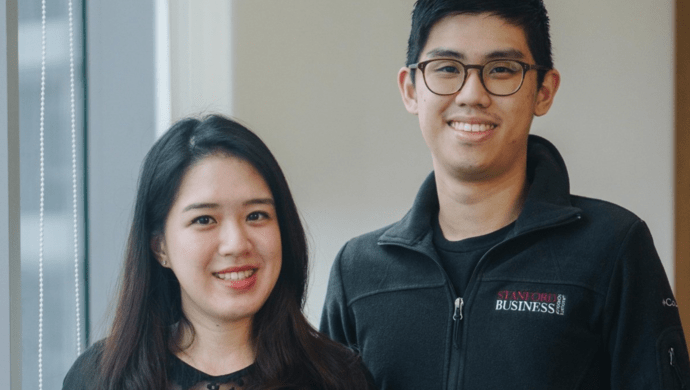

Ajaib co-founders
Ajaib has closed US$270 million in equity financing from Japan’s SBI Holdings, a Series C the Jakarta-based fintech says was significantly oversubscribed and priced above its 2021 unicorn valuation, the largest sum raised by an Indonesian tech company in over four years.
The round brings Ajaib’s total funding past US$500 million, with earlier backers including DST Global and Ribbit Capital, following an earlier US$65M Series A from the same investor group.
Founded in 2019 by Stanford MBA classmates Anderson Sumarli and Yada Piyajomkwan, Ajaib began as a simple stock-trading app for first-time investors and has since expanded into crypto, US equities, payments, savings and stablecoin infrastructure. SBI isn’t coming in as a passive investor — it’s a strategic partner bringing brokerage, digital banking and digital-asset expertise, with chairman Yoshitaka Kitao framing the deal around tokenisation and the convergence of traditional and digital finance.
The raise lands at a moment when Singapore’s fintech funding has fallen sharply and late-stage capital across Southeast Asia has grown harder to secure, signalling that strategic money is still available for companies with scale and clear regulatory positioning. It also follows a broader regional pattern of super-apps chasing profitability, echoed in GoTo’s first profit signals a fintech-driven future.
Ajaib says the capital will fund regional expansion and hiring, as it competes against Stockbit, Bibit, Pluang, Pintu and Indodax at home, and Robinhood, Coinbase and Revolut abroad.
Editor.
REGIONAL
fileAI expands into Japan with new SMBC, Singtel Innov8 backing: Singapore’s fileAI has secured undisclosed investment from SMBC Asia Rising Fund and Singtel Innov8 to fund its Japan expansion and the rollout of fileScout, its new unstructured-data mapping product.
Malaysia’s OSKVI, Affin Hwang launch Pothos venture debt fund: OSK Ventures International and Affin Hwang Investment Bank have launched Pothos Fund I, a three-year venture debt fund targeting revenue-generating, high-growth Southeast Asian companies with stronger cash flows.
Singapore fintech funding falls to US$499M as dealmaking narrows: Fintechs in Singapore raised just US$499 million across 53 deals in H1 2026, KPMG’s Pulse of Fintech report found, a near-decade low, with two-thirds of the total from a single cross-border payments deal.
Rippling triples Singapore office as AI boom fuels global hiring: Workforce platform Rippling is expanding into a new Singapore office as tightening local talent competition pushes Singapore-headquartered firms to build international teams earlier in their growth.
ASEAN battery industry shifts from talk to factories and standards: At the 4th ASEAN Battery Technology Conference in Malaysia, the region confronted the industrial layer behind its EV ambitions, launching a Malaysia-Indonesia NMC-graphene pouch cell as a test of cross-border collaboration.
StashAway buys MakeGoodwill to add digital wills to its platform: Singapore’s StashAway has acquired digital wills platform MakeGoodwill, its first move beyond wealth accumulation, after finding three in four surveyed clients had no will at all.
A*STAR spin-off Bioactivx raises US$3M for synthetic skin grafts: Singapore deeptech startup Bioactivx has raised a pre-Series A round for Bioactiv Matrix, a fully synthetic, shelf-stable skin substitute for burns that needs no cold-chain storage.
Taiwan, Thailand deepen tech ties at Bangkok innovation day: Eleven Taiwanese startups pitched Thai corporates and investors at Taiwan Tech Solution Day in Bangkok, part of a cross-ministry push building on US$870 million in 2025 Taiwanese FDI into Thailand.
Singapore’s Aura launches private equity evergreen fund: The evergreen fund structure offers investors open-ended exposure to private equity without fixed redemption windows, a format gaining traction among family offices and high-net-worth individuals across Southeast Asia.
SEA data centres hit 85% equity raise mark since 2024: Tracxn data shows the bulk of regional data centre equity has been raised in under two years, reflecting accelerating infrastructure demand driven by cloud adoption and AI workloads across Southeast Asia.
Philippines and Meta agree on child safety measures after Zamboanga shooting: Following the Zamboanga social-media-linked shooting, Manila and Meta established a rapid response group and new content protocols, a rare instance of a Southeast Asian government extracting platform accountability commitments from Meta.
SEA EV sales accelerate as energy crisis deepens: Rising fuel costs are driving EV adoption across the region, with the energy crisis acting as a structural demand accelerant rather than a short-term spike.
Singapore leads global shopping app install growth at 67%: Adjust’s data puts Singapore ahead of all other markets in shopping app install growth, a signal of both consumer confidence and intensifying e-commerce competition in the city-state.
INTERVIEWS AND FEATURES
GenAI Fund: SEA’s real AI gap is trust, not language: Global models already speak Southeast Asia’s languages fine, says GenAI Fund’s Kai Yong Kang; the real barrier is whether enterprises trust AI to execute business processes securely at scale.
SEA isn’t losing the robotaxi race, it’s running a different one: Nevada just licensed 7,000 robotaxis in one announcement; Singapore runs 11. But that caution may be strategic; Grab is training autonomy systems on SEA’s chaotic traffic conditions first.
INTERNATIONAL
Meta’s US$1.8B child safety settlement hinges on flawed age-verification tech: The US state settlement commits Meta to sweeping platform changes, but enforcement depends on age-verification technology that researchers say remains unreliable, raising questions about real-world impact.
Meta agrees to restrict children’s access to apps in US states deal: As part of the settlement, Meta will overhaul default settings for minors across its platforms, changes that could set a precedent for how regulators in Southeast Asia approach platform accountability.
Capital F closes US$17M debut fund targeting the female economy: The fund backs startups serving women as consumers, entrepreneurs, and workers — a thesis gaining ground as gender-lens investing matures beyond ESG optics into dedicated VC strategies.
India’s Airbound raises US$37M to replace trucks with cargo drones: Airbound targets India’s freight sector with high-speed drones, a model with clear application across Southeast Asia’s archipelagic markets where last-mile logistics remain expensive and fragmented.
Amazon shuts down service Bezos once called “artificial AI”: The shutdown marks the end of a product Bezos publicly derided as superficially intelligent — a candid structural admission of the gap between AI marketing and genuine capability.
Bill Gates calls for robot tax and human-reserved jobs: Gates argues that governments must intervene with fiscal and labour policy to manage AI-driven displacement — a position likely to resonate in Southeast Asia, where manufacturing employment underpins economic stability.
Moody’s: AI boom shields Asia Pacific, but cushion is thinning: AI-hardware exports are masking weak domestic demand across the region, Moody’s Analytics warns, as inflation, currency volatility and an overstretched AI rally threaten the buffer.
Japan is moving into SEA faster than the West, quietly: Japanese outbound investment hit US$204 billion in 2025 as brands like Uniqlo and Muji pivot from factory floor to customer base across Vietnam, Indonesia and Thailand.
SEMICONDUCTOR
AI-driven memory shortage won’t ease until late 2027: analysis: HBM demand is crowding out capacity for phones, PCs and consoles as memory shifts from a cheapening component to a rationed one, with relief reaching AI infrastructure first.
Foxconn’s Shunsin to invest US$65M in chip packaging in Vietnam: The investment reinforces Vietnam’s growing role in advanced semiconductor packaging as global supply chains continue to diversify away from Taiwan and China.
OpenAI’s Jalapeño chip built for fast inference at scale: Benchmarks show OpenAI’s in-house silicon outperforms general-purpose GPUs on inference tasks, a move that could reduce OpenAI’s dependence on Nvidia and reshape the competitive AI chip landscape.
CYBERSECURITY
Deepfake scams are the new threat founder-led brands must face: A herbal-medicine entrepreneur’s face and voice were cloned by scammers to push unsafe diabetes treatments, the latest in a string of operational crises she’s learned to navigate.
AI
Nvidia closes in on Hugging Face acquisition: A deal would give Nvidia direct ownership of the world’s largest open-source AI model repository, consolidating hardware and model distribution under one roof and raising immediate antitrust questions.
100-plus AI companies call for action against rogue AI: OpenAI, Anthropic, Google, and over 100 others signed a joint statement urging coordinated global action on AI safety, framing misaligned AI as a near-term operational risk, not a distant theoretical concern.
AI memory crunch threatens Android app performance: Growing on-device AI workloads are straining Android RAM limits, with developers warning that memory constraints could bottleneck AI feature rollouts on mid-range devices dominant across Southeast Asia.
OpenAI’s executive exodus: what explains the departures?: A TechCrunch analysis unpacks leadership churn at OpenAI, pointing to structural tensions between the company’s non-profit origins, commercial ambitions, and Sam Altman’s consolidation of control.
THOUGHT LEADERSHIP
Why SEA agritech should build for M&A exits, not IPOs: With public listings unlikely for the sector, founders should build for strategic acquirers like food processors and plantation groups rather than chase venture-style IPO outcomes.
Agritech investors are learning that infrastructure matters most: Single-point farm apps are giving way to bundled platforms as investors realise physical rails, not software alone, determine which agritech companies actually scale in Southeast Asia.
Agritech’s next business model may stop charging farmers: Rather than billing smallholders directly, a new wave of agritech is shifting monetisation downstream to buyers and processors who’ll pay for traceability and compliance data.
Compliance, not speed, built the Philippines’ fintech boom: GCash parent Mynt’s potential US$8 billion IPO didn’t happen by accident — BSP’s regulatory plumbing went in years before the growth curve needed it, one contributor argues.
You built the brand; the internet let someone else use it: When an unrelated overseas platform began advertising under a similar identity, one Philippine fintech learned that AI-driven search has collapsed the geographic protection brands used to rely on.
The case for hybrid microfinance: AI plus social trust: AI-scored lending is quietly stripping out the group-solidarity mechanism that made microfinance work for decades, pricing the poorest borrowers highest rather than subsidising them.
SEA’s new startup playbook: from velocity to positioning: As AI collapses the cost of building competent products, brand becomes environmental rather than cosmetic — shaping what investors and customers believe before evaluation even starts.
What if you segmented customers before building the product?: Pricing bolted on three weeks before launch is a top reason products fail — willingness-to-pay research belongs upstream, not as an afterthought, one contributor writes.
The Philippines doesn’t need to build AI to gain an edge: As AI absorbs routine BPO work, the country’s next advantage may lie in training workers to judge AI output rather than merely execute tasks.
SEA’s next climate unicorn could be built from farm waste: Biochar sits at the intersection of haze reduction, soil health and carbon removal — with the Philippines and Thailand already generating certified carbon revenue from the material.
SEA’s next century will be built on bridges, not blocs: Rather than choosing between US, Chinese or Japanese technology, the region’s advantage may be becoming skilled at connecting capabilities from all of them, one contributor argues.
ASEAN’s second digital wave runs on megawatts, not software: Johor’s data-centre demand has more than doubled in a year to nearly 3.8GW, exposing a grid-delivery crunch that solar and gas alone can’t fix.
When the buyer is a bot: staying eligible in AI procurement: As B2B purchasing shifts to AI agents, SEA startups have an unusual edge; agents don’t care about brand reputation, only published, verifiable facts.
Taste is the last moat: swapping wearables for wine: After three years optimising a sleep score, one founder found that AI can collapse a learning curve but can’t replace the judgement built from lived experience.
How AI is speeding up Indonesia’s creative economy: A 90-episode microdrama series shot in three weeks shows what’s possible, but flat-dollar pricing on professional AI tools risks locking out most of Indonesia’s 27 million creative workers.
Asian startups have an investor problem nobody is naming: Unlike the US, Asia’s exited founders rarely become check-writing operator-investors, leaving founders stuck explaining validation channels their VCs have never heard of.
Will BlackRock keep buying to push Bitcoin past US$83,000?: BlackRock’s iShares Bitcoin Trust bought US$200.76 million in a single day as ETF reserves expanded US$22 billion since mid-August, with Bitcoin testing resistance near US$83,000.
Who really moves Bitcoin now? Fidelity’s nine-day buying streak: Fidelity clients have been net buyers for nine straight days as regulated ETF flows increasingly set the marginal price of Bitcoin over retail speculation.
Bitcoin touched US$81,000: rally or forced repricing?: A short squeeze wiped out US$260 million in Bitcoin shorts within four hours, but US Treasury bond buybacks doubling to US$4 billion suggest more than pure leverage is behind the move.
Is US$63,750 the only line between Bitcoin and US$62,000?: A surprise US jobs contraction and a major corporate treasury sale pushed Bitcoin below its 50-day moving average, with US$63,750 now the key support to watch.
The post Ecosystem Roundup: SBI leads US$270M round in Indonesia’s largest tech deal in years appeared first on e27.