
Four hours after powerful earthquakes devastated parts of Venezuela’s northern coast and the capital of Caracas, El Salvador’s President Nayib Bukele announced on X that he had offered aid to the Venezuelan government to help deal with the aftermath of the tragedy.
Ninety minutes later, Venezuela’s acting President Delcy Rodríguez retweeted the message from the Central American leader – a man whom the regime’s Chavista movement has long regarded as a political nemesis – not only thanking him for the offer but also instructing Venezuela’s foreign ministry to coordinate the support.
“Solidarity between our peoples is an invaluable force at times like these,” wrote Rodríguez, former vice president of ousted leader Nicolás Maduro.
Beyond the solidarity such tragedies inspire and the accompanying political rhetoric, Rodríguez has little room to turn away any government willing to lend a hand during this crisis.
The earthquakes have compounded problems created by years of economic and political strife, particularly for the overwhelmed healthcare system. The South American nation’s economic situation is critical, following disastrous fiscal management and the imposition of US economic sanctions on the Central Bank of Venezuela and the state-owned oil company, Petróleos de Venezuela (PDVSA). Between 2013 and 2021, the country’s economy shrank by three-quarters.
Figures from the Central Bank of Venezuela offer a glimpse into the magnitude of the task facing Rodríguez. In 1998 – the year before Hugo Chávez took office – the country’s total external debt stood at US$28.311 billion. Twenty years later, in the last year for which official figures in this category were published, the country owed US$108.369 billion.
Economist Asdrúbal Oliveros, of the Institute for Economic and Social Research at Andrés Bello Catholic University, currently estimates the figure at US$161.3 billion – an estimate far lower than the US$240 billion figure reported by the Financial Times, which was released on the same day the earthquakes struck.
The grim forecast from the US Geological Survey, projecting billions of dollars in losses and thousands of deaths, evokes memories of another tragedy that occurred more than 27 years ago, in December 1999, during Chávez’s presidency.
On December 15 of that year – the very day a vote was held to approve the new Constitution proposed by the Chavista movement – a massive landslide struck several areas of Venezuela’s central coast, wiping out the entire town of Carmen de Uria in La Guaira state (which was then called the state of Vargas), and claiming hundreds of lives.


A month later, the Venezuelan government rejected the arrival of two humanitarian aid ships sent by the United States at the request of the then-defense minister, Major General Raúl Salazar. This was a highly controversial decision, given the extent of the destruction and the number of reported missing persons.
Years later, I interviewed Salazar, then retired from active military service, for the Venezuelan newspaper where I worked and asked him about that episode. The high-ranking officer told me that then-President Chávez had refused the aid because he viewed it as a violation of sovereignty, though he also suspected the refusal stemmed from the forging of an alliance with Cuban leader Fidel Castro – a partnership that was just beginning at the time.
Chávez never publicly addressed this specific episode. In January 2007, the then-president declared socialism in Venezuela and began positioning himself as the leader of anti-imperialism in Latin America, bolstered not only by his alliance with Castro but also by the support of the governments then in power in Brazil, Argentina, Ecuador, and Bolivia, while using the country’s immense wealth as a geopolitical weapon to advance his diplomacy.
“We will be there for our new and great friends”
The very same area affected by the 1999 landslide has been hit hardest by last week’s earthquakes. That past decision by Chávez has resurfaced on social media as an example of what must not be repeated. The context has shifted following the US capture of Maduro and his wife, Cilia Flores, and the close relationship—unimaginable just last December—that the Trump administration has forged with Rodríguez.
Following the deadly quakes, US President Donald Trump himself declared the US was “ready, willing, and able to help,” even before Rodríguez publicly asked for assistance, showing the growing influence of the White House in the South American nation.
“I have instructed all agencies of our government to get ready to move quickly,” the president wrote on Truth Social. “We will be there for our new and great friends.”


US Secretary of State Marco Rubio announced that the United States would immediately deploy search-and-rescue teams, medical resources, and humanitarian aid to the South American country. In addition to equipment to assess damage and locate victims, the US will provide $150 million in aid to Venezuela, the State Department announced. It pledged a $100 million contribution to a UN humanitarian fund for Venezuela and $50 million to aid organizations already working in the country.
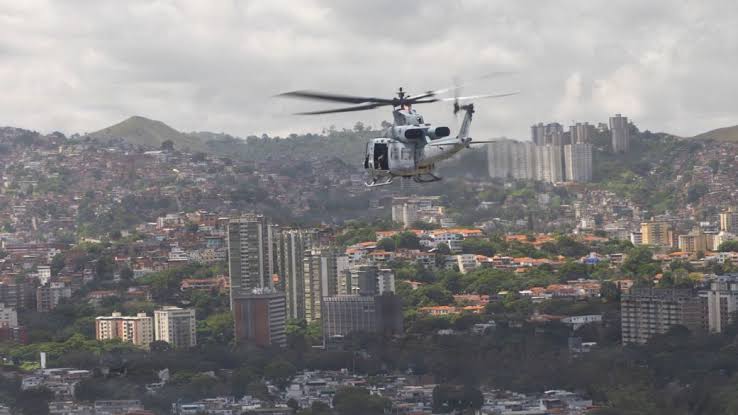
Civilian volunteers and rescue teams from around the world have poured into the country to search through the rubble, including teams from the US and several Latin American countries. Rodríguez said on Saturday night that 24 countries had sent aid and more than 2,700 rescuers were in the country to help with search operations. Venezuelans have voiced frustration over the government’s delayed response and lack of heavy machinery to recover loved ones.
Heroic efforts by international and local rescue teams have provided moments of hope and relief. US teams rescued an infant from beneath the rubble, the US State Department said. Rescue workers from El Salvador successfully freed a 15-year-old girl and her dog who were trapped inside a collapsed building in the city of Catia La Mar, La Guaira, according to President Bukele, and also rescued a woman who was trapped for 86 hours.
Given the scale of the tragedy and the size of its foreign debt, Venezuela needs far more than the aid now arriving to assist those affected and rebuild its infrastructure.
National Assembly President Jorge Rodríguez, the brother of acting President Delcy Rodríguez, said on Sunday that more than 12,000 people have been displaced by the earthquakes and 774 buildings have been damaged or destroyed, including hospitals. According to the UN’s agency for children, UNICEF, about 680,000 children are estimated to be in need of humanitarian assistance.
The aftermath of the earthquakes has worsened an ongoing crisis that has forced millions of Venezuelans to live in a war-like economy over the last decade, despite the country not being in a formal armed conflict.
The prospect of improved living conditions seems to be slipping away, burying the modest progress the Rodríguez administration could boast of after less than six months in office: the design of a legal framework more favorable to private investment, a slight increase in the country’s oil production, and a drop in inflation to 6.3% in May from the 10.6% reported by the Central Bank of Venezuela in April.
And this time—unlike the first year of the Chávez administration, when some Venezuelans still saw the new president as a source of hope — neither oil revenues nor all the international aid combined will be enough to mitigate the effects of the most powerful earthquake in a century.