

Updated ,first published
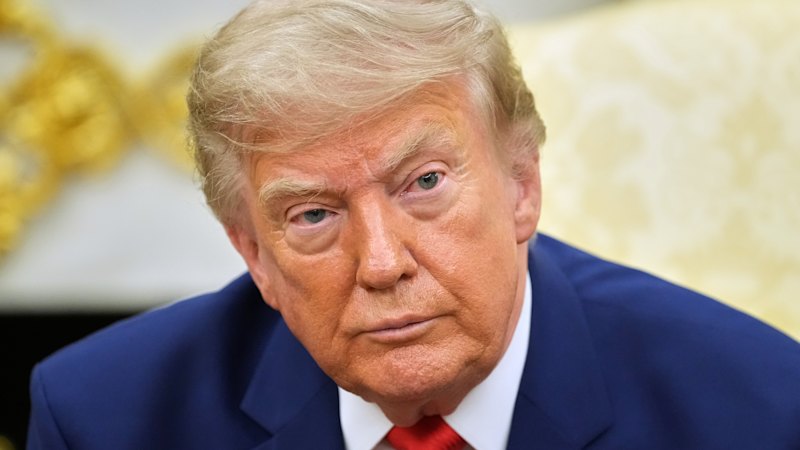
Washington: President Donald Trump declared he will bomb Iran’s Pickaxe Mountain nuclear site “pretty soon”, while appearing to blame US partner Jordan for the deaths of at least two American troops when an Iranian missile hit a Jordanian air base last week.
The US military has now released the identities of three service members killed in the renewed fighting, including 19-year-old Isabella Gonzales and Tyler Feehan, 25, who died at the Muwaffaq Salti Air Base in Jordan.
A third soldier is missing, with unidentified remains found, while another – now identified as 30-year-old Michael Swinton – died during the disposal of an Iranian drone in Iraq.
Trump on Tuesday (Washington time) appeared to blame the Jordanian military for failing to stop the missile reaching its target.
“[The Iranians] did slip something through in Jordan, and if we had other operators, it would not have happened, unfortunately,” he said.
“We have the best equipment in the world, we’ve stopped almost everything. But when you let other people do your job – with the United States, we let other people do the job – and sometimes it doesn’t work out so well.”
Trump also gave his strongest signal to date that he intends to authorise a strike on Iran’s Pickaxe Mountain, a key nuclear site buried deep underground near the Natanz facility that was bombed by the US last year.
“We’ll be hitting that area probably pretty soon and there’s not a thing they can do about it,” he told reporters in the Oval Office. “Normally, I wouldn’t say that. If I thought they could do something about it, I would never say that. But we’ll be hitting that area pretty soon, and very heavily.”
Trump has repeatedly threatened to strike Pickaxe Mountain since the conflict in Iran roared back to life two weeks ago after the Islamic Revolutionary Guard Corps resumed firing at ships in the Strait of Hormuz.
So far, US forces have mostly targeted coastal surveillance assets, missile and drone launch sites, command centres and air defence systems along the Iranian coastline, and in some other areas.
Mystery surrounds the exact purpose of Pickaxe Mountain. The Wall Street Journal reported on Tuesday that Israeli intelligence believes Iran relocated thousands of centrifuges – used to enrich uranium – into tunnels deep inside the mountain, and had relayed this to the US.
Trump was unfazed when asked about the report, saying he was focused on tracking any Iranian stockpiles of enriched uranium. “That’s where the action is.”
Meanwhile, the risk of the conflict further infringing upon global shipping escalated, with at least two tankers turning around in the Red Sea after Iran-backed Houthi militants in Yemen threatened to attack ships in the Bab el-Mandeb Strait.
Ship tracking data from LSEG showed a crude carrier, the Xin Long Yang, made a U-turn and headed back towards the Suez Canal, rather than trying to cross the strait bound for China, Reuters reported. It was carrying 2 million barrels of Saudi Arabian crude oil.
Aframax tanker Rodos, which loaded about 700,000 barrels of Saudi crude for India, also made a U-turn for Suez on Tuesday, according to the data.
Gregory Brew, an Iran and oil analyst at the Eurasia Group consultancy, said the data showed at least five tankers carrying Saudi oil or bound for Saudi ports had stopped or turned around near the strait. “Non-Saudi traffic continues apace,” he said.
The Iran-aligned Houthi rebels in Yemen largely sat out the conflict over the past five months, but on Monday declared a blockade on Saudi Arabia and warned shipping companies that vessels using Saudi ports could be targeted.
Trump was nonplussed about the potential escalation. “If something like that happens, we’ll take care of it. We’ve done that with the Houthis before,” he said.
Meanwhile, US Defence Secretary Pete Hegseth told a hearing of the Senate Appropriations Committee in Washington that the war against Iran had now cost $US37.5 billion ($53.16 billion), an increase of $US8 billion since the last public estimate.
General Dan Caine, chairman of the joint chiefs and the president’s top military adviser, faced questions about whether the US deliberately targeted desalination plants inside Iran, possibly violating international law.
Iranian state media reported that the Bonji desalination plant – which provided water to more than 10,000 people in 20 villages – was destroyed by a US missile.
“I’m not aware of those being particular targets, nor I am aware of those reports,” Caine said. He undertook to find out what had happened, but maintained confidence in US forces to always act ethically.
With Reuters
Get a note directly from our foreign correspondents on what’s making headlines around the world. Sign up for our weekly What in the World newsletter.
 Michael Koziol is the North America correspondent for The Age and Sydney Morning Herald. He is a former Sydney editor, Sun-Herald deputy editor and a federal political reporter in Canberra.Connect via X or email.
