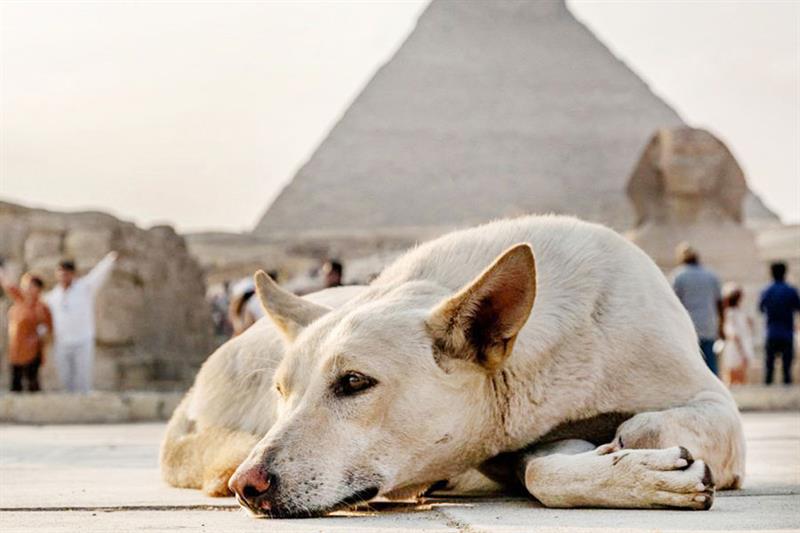
Egypt’s Ministry of Agriculture and Land Reclamation has announced on Friday 17 July the immediate implementation of a unified national strategy for managing street animals, reaffirming that sterilization, rabies vaccination, and the Trap-Neuter-Return (TNR) program will remain the country’s official approach to controlling stray dog populations.
The announcement also prohibits the use of poisons, mass culling, and the unauthorized relocation of street animals outside the designated framework. The ministry said violators would face immediate legal action.
The strategy follows a joint coordination conference hosted by the Egyptian Military Academy and attended by Agriculture Minister Alaa Farouk, Minister of Local Development and Environment Manal Awad, representatives from the Ministries of Justice, Housing, Social Solidarity and Endowments, the Egyptian Veterinary Syndicate, as well as security, regulatory and sovereign bodies. According to the ministry, the meeting resulted in the formation of a committee tasked with unifying veterinary sector policies and overseeing issues related to street animals and broader veterinary services.
TNR Remains Egypt’s Official Policy
The ministry said Egypt’s new strategy aligns with its commitments under the Convention on Biological Diversity (CBD), the Kunming-Montreal Global Biodiversity Framework, and international standards issued by the World Organisation for Animal Health (WOAH).
Officials described the TNR program, where stray dogs are trapped, sterilized, vaccinated against rabies, and returned to their original locations, as the only internationally recognized scientific and veterinary approach for managing street dog populations while preserving ecological balance.
The ministry also called for an immediate halt to any individual or uncoordinated actions outside the national framework, stressing that only approved authorities may oversee stray animal management.
Ministry Highlights Environmental Role of Street Animals
In its statement, the ministry argued that domesticated street animals contribute to Egypt’s environmental balance by helping limit the spread of rodents and venomous reptiles.
It added that climate change has contributed to a significant increase in the reproduction rates of certain dangerous reptiles and rodents, describing street animals as “the first natural environmental line of defence” against these populations. The ministry said disrupting this balance could pose risks to public health and urban environmental security.
The statement also cited scientific studies conducted by Egypt’s Academy of Scientific Research and Technology and specialized medical committees, saying that depriving street animals of food and water can increase aggressive behaviour as animals compete for survival. According to the ministry, this reinforces the need for vaccination, sterilization, and scientifically managed population control rather than punitive measures.
Legal Action Against Violations
The ministry urged citizens, civil society organizations, businesses, and local authorities to comply with the national strategy and refrain from taking independent actions outside the approved framework.
It added that legal measures would be taken, in coordination with security and regulatory authorities, against practices that violate the plan or spread misinformation about the issue.
Broader Veterinary Sector Reforms
Beyond stray animal management, the newly formed committee will also oversee reforms across Egypt’s veterinary sector, including strengthening biological threat preparedness, improving veterinary education and scientific research, modernizing slaughterhouses, laboratories, and veterinary units, supporting livestock, fisheries and poultry development, updating legislation, and expanding digital databases and smart platforms designed to improve crisis prediction and resource management.
The announcement comes amid ongoing debate over Egypt’s estimated 10 to 11 million stray dogs, with repeated dog bite incidents prompting calls for stronger public safety measures while animal welfare groups continue to advocate against culling in favour of sterilization and vaccination programs.