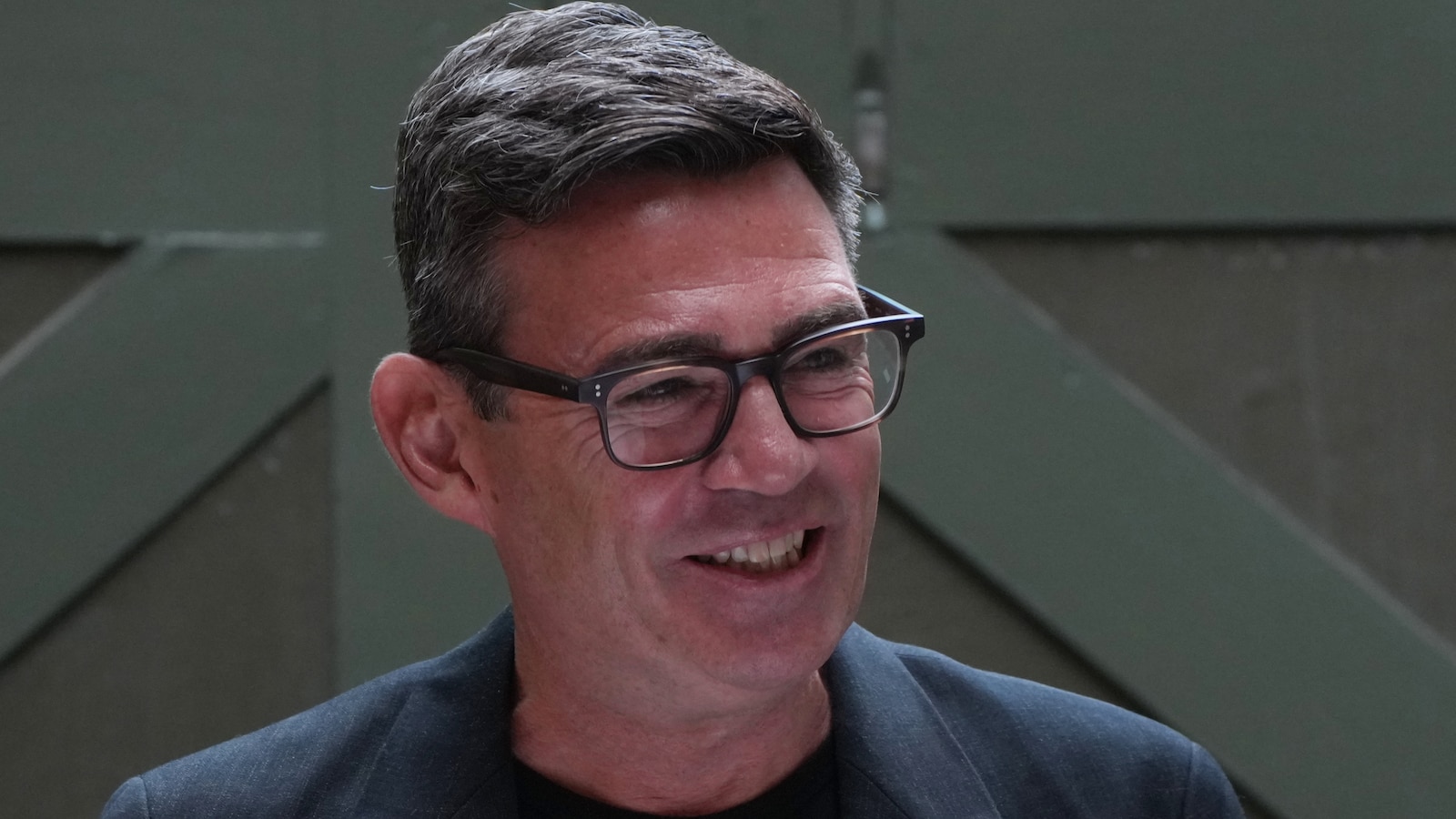


Days after Lithuania said its intelligence services had caught Russia preparing sabotage against the infrastructure that ties the Baltics to Europe, Foreign Minister Kestutis Budrys drew a public line.
If those plans are carried out, he said, Vilnius will not treat the results as accidents. “If there is damage, or if there are casualties, it will be treated as an act of aggression, with all the due consequences,” Mr. Budrys said in an interview with The Washington Times at the foreign ministry. That means, he added, “not only the country’s self-defense but the collective defense of the alliance.”
The warning, which President Gitanas Nauseda disclosed this week, points to Russian planning approved, as Mr. Budrys put it, “at the highest levels in Moscow.” He tied it directly to the war. Moscow sees that Ukraine has not only stopped its army but taken the lead in striking the refineries and pipelines that feed its war machine, he said, and a Kremlin under that pressure is weighing cheaper ways to answer.
The intelligence, he said, points to “considerations regarding our critical infrastructure here in the region,” with false-flag operations “not excluded.”
It comes as the one deterrent Vilnius trusts most, a standing American presence, is itself unsettled.
About 1,000 U.S. soldiers rotated out of Lithuania last month, and the Pentagon has not said whether or when they will be replaced.
Mr. Budrys says he is pressing the case, and is confident of it.
“We want U.S. troops to remain deployed in Lithuania,” he said. “We are still waiting for a concrete timeline, and for the format, size and numbers that military planners need, but we are optimistic about the outcome.”
Lithuania is the ally Washington spent a decade urging Europe to become. It spends more of its economy on defense than any other member of the alliance, 5.4% of gross domestic product this year, hosts American forces, buys Western weapons, backs Ukraine without reservation and has paid an economic price for confronting China. If the most compliant ally on the eastern flank cannot be sure the troops will stay, officials in Vilnius have reason to wonder who can.
The worry crosses party lines. The Social Democrats who beat the conservatives in the 2024 election promised a new course on taxes and social spending, not on defense.
On Russia and Washington, Lithuania’s parties barely differ. All of them back Ukraine, spend heavily and keep the United States engaged.
Mr. Budrys describes the danger as growing rather than imminent. Russia is redeploying forces on its western and northwestern flank, he said, standing up “new divisions instead of brigades” facing the Baltics even as it grinds forward in Ukraine. “We cannot allow Russia numerical dominance in the region, and we cannot allow a short-notice or no-notice scenario,” he said.
The answer, he argued, is not to match Moscow soldier for soldier but to make allied forces “deployable here faster.” That, he said, “is why remaining here matters so much.”
The nearer danger is Ukraine’s. Russia is preparing a hard winter for it, Mr. Budrys said, with mass drone and ballistic-missile strikes aimed at the power grid.
Ukraine’s counter-drone defenses hold, he said, but it lacks the interceptors to stop ballistic missiles, and more targets are getting through than before. Lithuania is filling what gaps it can. It is Ukraine’s top supplier of power generators and among the world’s top suppliers of transformers, he said, and it dismantled one of its power plants and shipped it across the border.
The American decision to let Ukraine build its own PAC-3 interceptors for Patriot systems, he added, is “a huge success,” and “when it is fully executed it matters for us.”
Margarita Seselgyte, who directs the Institute of International Relations and Political Science at Vilnius University, is blunt about why it has to be American troops.
Russia, she said, reads deterrence only through American power. “Putin understands deterrence only with the Americans,” she said. “For him, the Europeans are not enough.”
Mr. Budrys does not read the lapsed rotation as a verdict. That deployment, he said, sat within U.S. and bilateral planning rather than NATO’s, and Lithuania remains “thankful for the troops that were deployed here,” which is why it provides host-nation support “among the best in the world.”
From Ankara, he said, Lithuania got what it wanted, a show of unity, an American presence led by the president and the upgrade of Baltic air policing to an EU air-defense operation with the authority to bring down threatening drones. “It means we will be more secure,” he said.
He rejects the idea that Lithuania spends to be noticed. Reaching a number is not the result, he said. Turning money into capabilities is.
“That is how we ended up spending 5.4% of GDP,” he said, to field the battle-ready division Lithuania has promised NATO. “Otherwise our deterrence is weak, and weak deterrence gets tested, which means the war we all want to avoid.”
For allies still short of their pledges he had a blunter line. “There is no need for out-of-the-box thinking here,” he said. “Just implement what you pledged. Go and do it.”
Analysts read the spending differently. Ms. Seselgyte said Lithuania set its budget higher than security alone would dictate, partly to send Washington a message. “This is a bold move to send a message to the United States that we are the first ones,” she said, and part of the reason is “to please President Trump.” Mr. Budrys frames the same figure as deterrence, not courtship.
Behind the diplomacy, Lithuania is building what it can at home, with German firms as anchors.
A venture run by Rheinmetall and KNDS, with a state energy company buying in, is moving from repairing armor to assembling Leopard tanks near Kaunas, and Rheinmetall is building a plant at Baisogala to make artillery shells. Lithuanian firms now produce laser targeting units for drones that carry no U.S. export controls, so allied buyers need not wait on a decision from Washington.
Above all, Germany is permanently basing a brigade in Lithuania, its first such deployment abroad since World War II. “By the end of 2027 we expect a full, combat-ready German brigade here,” Mr. Budrys said. “That is one of the guarantees that makes those Russian scenarios less probable.”
Not everyone believes the country can build its way to security. Augustinas Vizbaras, a co-founder of the laser maker Brolis Group, has said Lithuania is too small to sustain weapons technology that can compete abroad, and that it buys first and creates last.
Vidmantas Janulevicius, who heads the Lithuanian industrialists’ confederation, has said Ukraine no longer wants many Lithuanian drones now that it builds its own.
Mr. Budrys, who once assumed demand alone would pull a defense industry into being, concedes it did not. Money is not enough, he said, without “better interaction between political decision-makers and industry,” and without room for the startups the war in Ukraine has pushed to the center of the field.
Asked whom in Washington Lithuania counts on, Mr. Budrys reached first for Lindsey Graham, the senator whose Russia sanctions bill was reintroduced this week after his death. “Lindsey Graham will always rest in our hearts,” he said, tracing a “heartfelt closeness” to the United States back to the 1940 Welles Declaration, by which Washington refused to recognize the Soviet annexation of the Baltic states.
But his real answer was about leadership, not any single branch. Every serious move against Russia, he said, has needed the United States in front to pull a slow Europe along.
“We are too slow and too late,” he said of the bloc’s sanctions. “Before each package we say it will be the biggest and most ambitious, and then we delete and delete until what remains has no real influence on Russia’s decisions.” A sanctions debate in Congress, he said, would let Europe raise its own ambition, as Mr. Graham’s bill did a year ago.
On the NATO summit earlier this month, Ms. Seselgyte said it calmed the worst fears without settling the deeper one.
“Everyone feared the worst, and the worst didn’t happen,” she said, meaning an American pullback from the command structures, nuclear umbrella and intelligence-sharing Europe cannot yet replace.
On whether the presence is secure, she was shorter. “With Trump you never know.”
On China, Mr. Budrys resists the reading that Lithuania is retreating because it doubts American cover.
Lithuania “suffered the worst economic coercion from China of any targeted nation in recent years,” he said, cut out of Beijing’s customs system in 2021, in what he called a plain violation of trade rules, after it let Taiwan open an office under its own name.
Five years on, he said, trade has recovered, and the European Union has built an anti-coercion instrument that answers such pressure collectively. What is left, he said, is ordinary statecraft, keeping embassies open in both capitals and getting relations “to the level that any other country in Europe, and the United States, has.”
Analysts see a quieter surrender. The original Taiwan gesture, Ms. Seselgyte said, was aimed less at Beijing than at Washington.
“Why did we make the original move? To keep America in,” she said. The hard line was the signature of the previous conservative government and its foreign minister, Gabrielius Landsbergis, among Europe’s toughest voices on China.
Mr. Budrys keeps a lower profile even as the aims hold.
To its critics, the timing is the point. Lithuania is easing its stance as American cover looks less certain. Ms. Seselgyte was blunt. A country that breaks a promise to Taipei, she said, “behaves like a banana republic.”
In January, Lithuania takes over the presidency of the European Union Council for six months, inheriting the very files it is now fighting over, among them a 21st sanctions package the bloc again failed to agree to implement this week.
Mr. Budrys casts the coercion Lithuania survived as an asset that forced it to build screening tools for investment, technology and contracts it now shares with others.
He wants to use the chair to push a stronger conventional defense in Europe, what he calls “NATO 3.0,” paid for with European money and, he stressed, still coordinated with the United States.
The war in the Persian Gulf is Lithuania’s concern too, and pressed on an American perception that Europe is soft on Iran, Mr. Budrys answered by cataloging the threat.
Iran’s nuclear program is a global danger, he said, and its missiles already reached allied territory when the fighting began, putting Lithuania in range.
Its proxies, Hamas and Hezbollah, spread an instability that does not stop at Israel. Iranian intelligence, he added, already operates inside Europe against people it considers enemies.
The renewed U.S. strikes are lifting energy prices and inflation, he said, and draining the air-defense interceptors that Ukraine and the Baltics need for their own skies. That is why Europe has to help end it, he argued.
Lithuania has committed to join an eventual operation to secure the Strait of Hormuz, whether the United States, Britain or France leads it.
“Once a force is deployed there, we will be there,” Mr. Budrys said. Lithuania would go, he added, “to be part of the solution, because it affects us.”